Managing wholesale inventory is complex. Unlike retail businesses that handle smaller quantities and direct-to-consumer sales, wholesalers deal with bulk purchasing, multi-location storage, supplier coordination, fluctuating demand, and tight profit margins. A minor miscalculation in stock levels can result in overstocking, cash flow issues, or lost customers.
This is where custom erp software development becomes a strategic advantage. Instead of relying on generic systems that only partially address operational needs, wholesalers can implement tailored ERP solutions that align with their workflows, reporting requirements, and growth goals.
Understanding the Inventory Challenges in Wholesale Businesses
Before implementing a solution, it’s essential to understand the core challenges wholesalers face.
Complex Stock Management
Wholesale inventory typically includes:
- Large SKUs (Stock Keeping Units)
- Multiple warehouses
- Bulk purchasing cycles
- Varying supplier lead times
Managing this manually or through disconnected systems increases the risk of errors.
Demand Volatility
Wholesale demand fluctuates due to:
- Seasonal buying trends
- Retailer promotions
- Market disruptions
- Supply chain delays
Without predictive data and automation, forecasting becomes guesswork.
Cash Flow Sensitivity
Inventory ties up capital. Overstocking reduces liquidity, while understocking leads to missed revenue opportunities.
Fragmented Systems
Many wholesalers use separate tools for accounting, CRM, inventory tracking, and procurement. This leads to:
- Duplicate data entry
- Reporting inconsistencies
- Operational inefficiencies
Custom ERP solves these fragmentation issues.
What Is Custom ERP Software Development?
Custom erp software development refers to building an Enterprise Resource Planning (ERP) system specifically tailored to a business’s operational processes, data structures, and long-term objectives.
Unlike off-the-shelf ERP systems, custom solutions are:
- Fully aligned with business workflows
- Scalable as operations expand
- Integrated with existing tools
- Built with industry-specific logic
For wholesale businesses, this means that inventory, procurement, sales, accounting, and logistics operate within one unified ecosystem.
Why Off-the-Shelf ERP Systems Often Fall Short
Generic ERP systems may offer standard inventory modules, but wholesalers often encounter limitations.
Limited Customization
Pre-built systems may not:
- Support bulk pricing tiers
- Handle complex distributor relationships
- Allow multi-warehouse synchronization
- Integrate with niche platforms
Unnecessary Features
Many ERP platforms include features irrelevant to wholesalers, making the interface cluttered and inefficient.
Scalability Restrictions
As your wholesale business grows, generic ERP systems may require expensive upgrades or workarounds.
With custom erp software development, you build exactly what you need—nothing more, nothing less.
Key Features of Custom ERP for Wholesale Inventory Management
To effectively manage wholesale inventory, your custom ERP should include the following core capabilities.
Real-Time Inventory Tracking
A custom ERP system provides:
- Automated stock adjustments
- Warehouse-level visibility
- Serial and batch tracking
This ensures decision-makers always operate on accurate data.
Multi-Warehouse Management
For wholesalers operating across regions, ERP systems can:
- Synchronize stock between locations
- Track transfers
- Optimize warehouse allocation
- Reduce redundant inventory
Automated Reordering and Alerts
Custom ERP systems can:
- Set minimum stock thresholds
- Trigger automatic purchase orders
- Notify procurement teams
- Analyze supplier lead times
This minimizes stockouts and overstocking.
Demand Forecasting and Analytics
Advanced ERP modules integrate:
- Historical sales data
- Seasonal trends
- Customer buying patterns
- Predictive analytics
This transforms inventory planning from reactive to proactive.
Integration with Accounting and CRM
Wholesale inventory doesn’t operate in isolation. Custom ERP integrates:
- Financial systems
- Sales pipelines
- Customer credit management
- Tax calculations
Everything becomes interconnected and transparent.
How Custom ERP Improves Operational Efficiency
Implementing custom erp software development creates measurable efficiency gains.
Centralized Data Management
All departments operate from a single data source, eliminating inconsistencies and duplicate records.
Reduced Manual Errors
Automation reduces:
- Data entry mistakes
- Miscounts
- Billing errors
- Procurement delays
Faster Order Processing
ERP systems automate:
- Order confirmation
- Inventory allocation
- Invoice generation
- Shipping updates
This improves turnaround time and customer satisfaction.
Better Decision-Making
Executives gain access to:
- Real-time dashboards
- Inventory turnover rates
- Slow-moving stock reports
- Profit margin analysis
Strategic decisions become data-driven rather than intuitive.
The Role of IT Agency Services in USA in ERP Implementation
Implementing a custom ERP system is not just about coding software—it requires strategic planning, system architecture, security considerations, and long-term scalability planning.
Professional IT agency services in USA provide:
Business Process Analysis
Before development begins, experts:
- Map existing workflows
- Identify bottlenecks
- Define automation opportunities
- Establish measurable KPIs
Custom Architecture Design
ERP systems require:
- Secure database structures
- API integrations
- Cloud infrastructure planning
- Role-based access controls
Compliance and Security
Wholesale businesses often handle:
- Financial data
- Customer records
- Supplier contracts
An experienced IT agency ensures compliance with data protection standards and implements robust cybersecurity measures.
Ongoing Maintenance and Support
ERP systems evolve as businesses grow. Reliable IT partners provide:
- System upgrades
- Feature enhancements
- Performance monitoring
- Technical support
This ensures long-term operational stability.
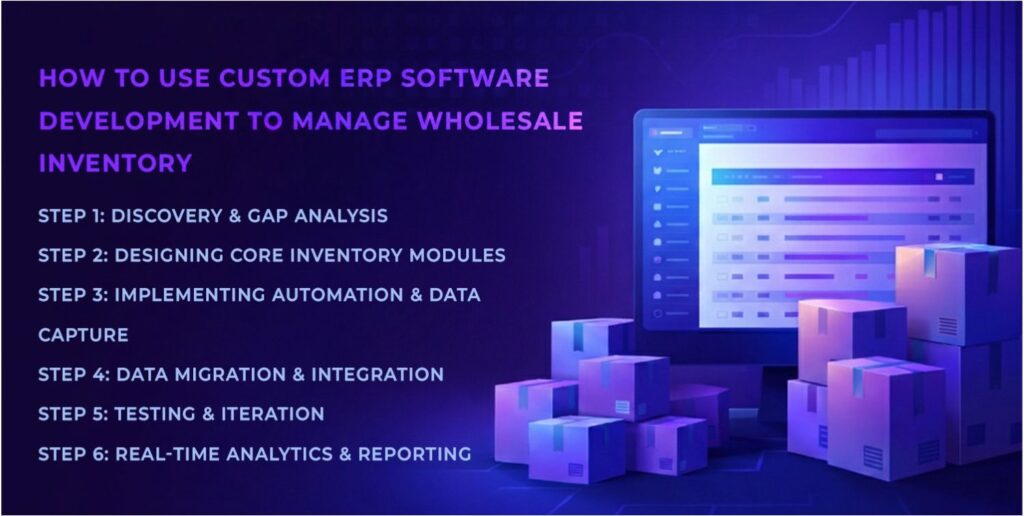
Step-by-Step Approach to Implementing Custom ERP
A structured implementation process ensures success.
Step 1: Requirement Gathering
Identify:
- Inventory pain points
- Reporting needs
- Integration requirements
- Growth projections
Step 2: System Design
Develop wireframes, workflows, and technical architecture tailored to wholesale operations.
Step 3: Development and Integration
Build modules for:
- Inventory
- Procurement
- Sales
- Accounting
- Warehouse management
Step 4: Testing and Optimization
Perform:
- Load testing
- Security testing
- User acceptance testing
Step 5: Deployment and Training
Train staff and ensure smooth transition from legacy systems.
Long-Term Benefits of Custom ERP for Wholesale Businesses
Custom ERP systems are strategic investments.
Scalability
As inventory volume increases, the system scales without disruption.
Cost Optimization
- Reduced storage costs
- Improved stock turnover
- Lower operational overhead
Competitive Advantage
Wholesale markets are competitive. Efficient inventory management enables:
- Faster fulfillment
- Competitive pricing
- Better customer retention
Improved Vendor Relationships
Data transparency improves communication with suppliers and strengthens partnerships.
Common Mistakes to Avoid During ERP Development
Even powerful systems can fail if implemented incorrectly.
Ignoring User Training
Technology adoption requires proper onboarding and documentation.
Overcomplicating the System
Focus on operational efficiency rather than unnecessary features.
Skipping Process Analysis
Automation without process refinement leads to digital inefficiency.
Choosing Inexperienced Developers
ERP systems require enterprise-level expertise. Working with experienced IT agency services in USA reduces implementation risk.
FAQs
1. What makes custom ERP software development better than ready-made ERP systems?
Custom ERP systems are built specifically for your wholesale business processes, ensuring better integration, scalability, and operational alignment compared to generic platforms.
2. How long does it take to develop a custom ERP system for wholesale inventory?
Depending on complexity, development can take anywhere from 3 to 9 months, including planning, development, testing, and deployment.
3. Is custom ERP suitable for small wholesale businesses?
Yes. Custom solutions can be modular, allowing small businesses to start with essential features and expand as operations grow.
4. Why should I hire IT agency services in USA for ERP development?
Experienced agencies provide technical expertise, strategic consultation, compliance support, and long-term maintenance to ensure system success and scalability.
Conclusion
Wholesale inventory management demands precision, scalability, and automation. Manual tracking systems and generic software often fail to address the complexity of bulk inventory operations, multi-location warehouses, and fluctuating demand cycles.Investing in custom erp software development enables wholesalers to centralize data, automate procurement, optimize stock levels, and make data-driven decisions. When implemented strategically with professional IT agency services in USA, businesses gain not only a technology upgrade but a competitive operational advantage.