In today’s competitive digital marketplace, having an ecommerce website is no longer enough to attract and retain customers. Online shoppers expect a smooth, convenient, and reliable shopping experience whenever they visit an online store. From browsing products to completing purchases, every interaction influences how customers perceive a brand and whether they decide to buy.
A poorly designed ecommerce website can create unnecessary challenges for visitors. Slow-loading pages, confusing navigation, complicated checkout processes, and unresponsive layouts can discourage potential customers from completing their purchases. Even businesses with high-quality products may struggle to generate sales if their websites fail to meet customer expectations.
This is where a professional Ecommerce Website Design and Development Company makes a significant difference. By combining creative design, advanced functionality, usability, and technical performance, experienced professionals can build online stores that deliver seamless shopping experiences. A well-developed ecommerce website helps customers find products easily, understand product information, complete transactions securely, and interact with a brand confidently.
1. Creates Simple and User-Friendly Website Navigation
Website navigation plays an important role in determining how easily customers can explore an online store. When visitors cannot find the products or information they need, they may leave the website and choose a competitor.
Professional ecommerce website design focuses on creating a clear navigation structure that helps visitors move between different sections without confusion.
Organizes Products into Clear Categories
A well-organized ecommerce website groups products into relevant categories and subcategories, making it easier for customers to browse different product collections without spending unnecessary time searching. An experienced Ecommerce Website Design and Development Company can create a structured navigation system that improves product discovery and helps customers find what they need more efficiently.
For example, an online clothing store can organize its products into categories such as men’s clothing, women’s clothing, footwear, accessories, and seasonal collections. Each category can include additional filters to help shoppers narrow down their choices based on size, color, price, and style.
A well-planned category structure and user-friendly navigation make product discovery easier, improve website usability, and create a more convenient shopping experience.
Includes Effective Search and Filtering Options
Customers often visit ecommerce websites with a particular product in mind. A visible search bar allows them to find specific products quickly.
Advanced search functionality can also include product suggestions, keyword matching, and relevant search results. Similarly, filtering options allow shoppers to narrow products based on price, size, color, brand, ratings, and other relevant attributes.
These features reduce browsing time and help customers make purchasing decisions more efficiently.
2. Improves Mobile Shopping Experience Through Responsive Design
Mobile devices have become an important part of online shopping. Many customers browse products, compare prices, and complete purchases using smartphones and tablets. An experienced Ecommerce Website Design and Development Company understands the importance of creating mobile-friendly online stores that deliver a consistent shopping experience across different devices.
If an ecommerce website does not function properly on smaller screens, businesses risk losing potential customers. Professional ecommerce website design incorporates responsive layouts that automatically adjust to different screen sizes and devices, ensuring customers can browse products, explore categories, and complete purchases conveniently.
Provides Consistent Experiences Across Devices
Responsive design ensures that website elements such as product images, navigation menus, buttons, and content remain accessible on different screen sizes.
For example, a desktop ecommerce website may display multiple products in a horizontal grid, while the mobile version adjusts the layout to show fewer products per row. This makes browsing more comfortable without requiring users to zoom in or scroll horizontally.
A consistent experience across devices allows customers to interact with an online store whenever and wherever they prefer.
Makes Mobile Purchasing More Convenient
Mobile-friendly shopping experiences should make essential actions simple. Buttons such as Add to Cart, Buy Now, and Checkout should be easy to identify and tap.
Forms should also be optimized for smaller screens, with readable text, appropriate spacing, and fewer unnecessary fields.
A well-optimized mobile checkout process reduces frustration and helps customers complete purchases without switching to another device.
3. Increases Website Loading Speed and Performance
Website speed directly influences customer experience. Online shoppers generally expect ecommerce websites to load quickly and respond smoothly when they interact with different pages.
A slow website can interrupt the shopping journey, reduce customer satisfaction, and increase the likelihood that visitors will abandon the store.
Optimizes Images and Website Resources
Large product images, unnecessary scripts, and unoptimized website files can negatively affect loading speed.
Professional developers use different optimization techniques to improve website performance, including:
- Compressing product images without significantly affecting their quality.
- Using modern image formats such as WebP where appropriate.
- Minifying CSS and JavaScript files.
- Implementing browser caching to reduce repeated loading.
- Using content delivery networks (CDNs) to distribute website resources efficiently.
These improvements help pages load faster and create a smoother browsing experience.
Improves Core Web Vitals
Google’s Core Web Vitals measure important aspects of website user experience, including loading performance, interactivity, and visual stability.
Three important metrics include:
- Largest Contentful Paint (LCP): Measures how quickly the main content becomes visible.
- Interaction to Next Paint (INP): Measures how quickly a website responds to user interactions.
- Cumulative Layout Shift (CLS): Measures unexpected layout movements during page loading.
A professionally developed ecommerce website should aim for good Core Web Vitals performance. This helps create a more stable and responsive experience while supporting broader website quality and SEO efforts.
4. Builds Customer Trust Through Professional Visual Design
Customers are more likely to purchase from an online store when they feel confident about the business and its products. Website appearance plays an important role in establishing that confidence.
An outdated or poorly designed website can create doubts about a brand’s credibility, product quality, and reliability.
Professional ecommerce website design creates a consistent visual identity that makes an online store look organized, trustworthy, and professional.
Maintains Consistent Branding and Visual Identity
A consistent visual identity helps customers recognize and remember a business. Professional designers use appropriate colors, typography, images, icons, and layouts to create a unified appearance throughout the website.
For example, an ecommerce brand selling premium skincare products may use clean layouts, subtle colors, high-quality product photography, and minimal visual elements to communicate quality and sophistication.
Consistency across product pages, category pages, and checkout screens also makes the website easier to understand and navigate.
Displays Trust Signals and Business Information
Customers want reassurance before sharing personal information or making online payments.
An ecommerce website should provide clear information about the business, including:
- Customer reviews and product ratings.
- Contact information and customer support details.
- Shipping, return, and refund policies.
- Secure payment options and appropriate security indicators.
- Clear product descriptions and genuine product images.
These elements help customers understand what to expect and reduce uncertainty during the purchasing process.
5. Simplifies the Checkout Process and Reduces Cart Abandonment
One of the biggest challenges for ecommerce businesses is cart abandonment. Customers may add products to their shopping carts but leave the website before completing their purchases.
A complicated checkout experience is one possible reason behind this behavior. Unnecessary form fields, unexpected costs, limited payment methods, and confusing checkout steps can discourage customers from placing an order.
Reduces Unnecessary Checkout Steps
A simple checkout process allows customers to complete their purchases with minimal effort.
Businesses can improve checkout usability by providing guest checkout options, reducing unnecessary form fields, displaying clear progress indicators, and allowing customers to review their orders before payment.
For example, instead of requiring customers to create an account before purchasing, an online store can offer guest checkout. This gives first-time visitors more flexibility and removes an unnecessary barrier.
Offers Multiple Secure Payment Options
Different customers prefer different payment methods. Some may use credit or debit cards, while others prefer digital wallets or other locally supported payment options.
Providing suitable payment methods gives customers more flexibility and improves convenience.
The checkout page should also clearly display order summaries, shipping charges, applicable taxes, and the final payable amount.
A transparent checkout experience helps customers understand exactly what they are paying for and builds confidence throughout the transaction.
6. Personalizes the Shopping Experience and Encourages Customer Engagement
Modern ecommerce customers expect more than a basic product catalog. They appreciate shopping experiences that reflect their interests, preferences, and purchasing behavior.
Professional ecommerce website design can integrate personalization features that make product discovery more relevant and encourage customers to explore additional products.
Recommends Relevant Products
Product recommendations help customers discover items that match their interests or complement their existing selections.
For example, an online electronics store can recommend phone cases, screen protectors, and wireless chargers to customers viewing smartphones.
Similarly, an online fashion store can display related products, recently viewed items, or matching accessories.
Uses Interactive Features to Improve Engagement
Interactive website elements help customers understand products and make informed decisions.
Some useful ecommerce features include:
- Product image galleries with zoom functionality.
- Product comparison tools.
- Wishlist options for saving favorite products.
- Size guides and product specifications.
- Live chat and accessible customer support.
- Recently viewed product sections.
These features allow customers to interact with products more effectively and reduce uncertainty before purchasing.
However, personalization should remain helpful rather than overwhelming. Recommendations and interactive elements should support the shopping journey without distracting visitors from their primary goals.
Why Should Businesses Invest in Professional Ecommerce Website Design?
A well-designed website does more than display products. It creates a structured shopping environment where customers can explore products, compare options, access important information, and complete purchases conveniently.
Businesses that invest in professional design can benefit from better usability, stronger brand credibility, improved mobile experiences, and more efficient purchasing journeys.
Working with an experienced ecommerce website design and development company also helps businesses build websites according to their specific requirements. From selecting the right ecommerce platform to integrating payment gateways and optimizing website performance, professional developers can create solutions that support both current operations and future growth.
Frequently Asked Questions (FAQs)
1. What Is Professional Ecommerce Website Design?
Professional ecommerce website design involves creating an online store that combines visual appeal, functionality, usability, and performance.
2. How Does Ecommerce Website Design Affect Customer Experience?
Ecommerce website design affects how customers interact with an online store. A well-designed website makes it easier to find products, navigate categories, compare options, and complete purchases.
3. Why Is Mobile Responsiveness Important for Ecommerce Websites?
Mobile responsiveness ensures that an ecommerce website works properly across smartphones, tablets, and desktop devices. It improves readability, navigation, product browsing, and checkout usability.
4. How Can Businesses Improve the User Experience of an Ecommerce Website?
Businesses can improve ecommerce user experience by simplifying navigation, optimizing website speed, using responsive design, providing high-quality product images, displaying clear product information, and reducing checkout complexity.
Conclusion
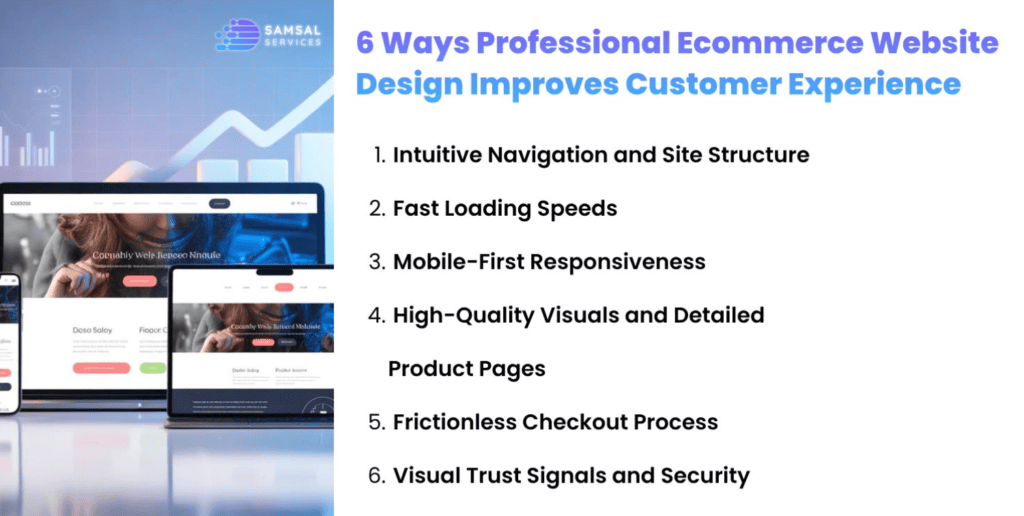
Professional ecommerce website design plays an essential role in creating positive customer experiences and building successful online businesses. From simple navigation and responsive layouts to faster loading speeds and secure checkout processes, every design element contributes to how customers interact with an online store.
The six strategies discussed above demonstrate how businesses can make online shopping more convenient, engaging, and reliable. By focusing on usability, performance, visual consistency, and personalization, ecommerce businesses can reduce purchasing barriers and encourage customers to return.
Samsal Services helps businesses build professional digital experiences through website design and development solutions tailored to their business goals. With a focus on functionality, performance, and user experience, businesses can establish a stronger online presence and create ecommerce platforms designed for sustainable growth.