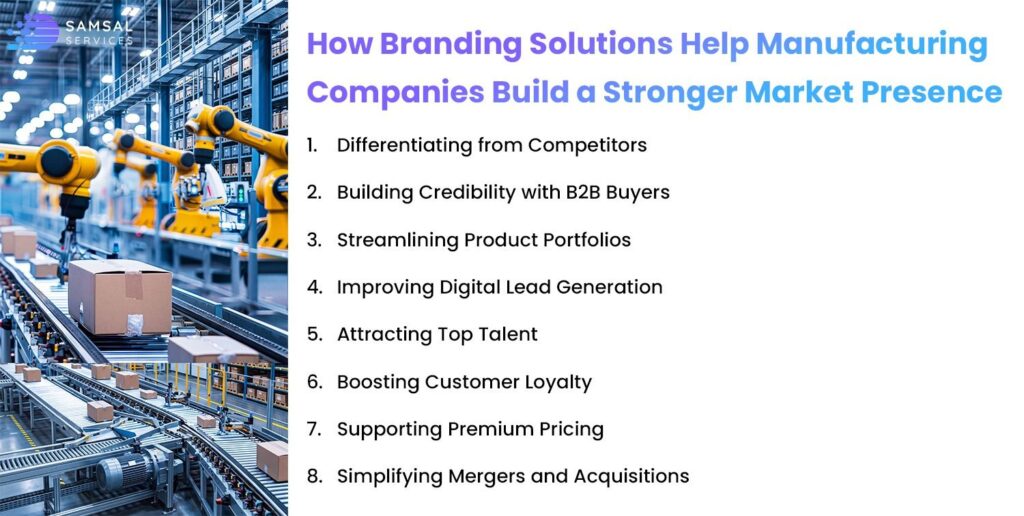
Manufacturing companies operate in highly competitive markets where product quality, pricing, reliability, and operational efficiency all influence purchasing decisions. However, having a quality product is not always enough to stand out. Today’s B2B buyers often research manufacturers online before contacting a supplier.
Branding solutions for manufacturing companies help businesses build a recognizable identity, communicate their value proposition, establish credibility, and create consistent experiences across marketing and sales channels. From brand strategy and visual identity to website design, packaging, content marketing, and digital communication, effective branding can influence how customers perceive a manufacturing business.
For manufacturers also investing in modernization, branding can work alongside digital transformation scale agile solutions and create a consistent connection between technology, customer experience, and business growth.
Why Branding Matters for Manufacturing Companies
Manufacturing branding is different from simply designing a logo. It involves defining how a company wants to be recognized within its industry and communicating that positioning consistently.
A strong manufacturing brand can help answer important questions for prospective customers:
- What does the company manufacture?
- Which industries does it serve?
- What makes its products different?
- Why should customers trust the manufacturer?
- What expertise and capabilities does it provide?
- How does it solve customer problems?
When these answers are communicated consistently, a manufacturing business becomes easier to understand and remember.
Manufacturing Buyers Research Before They Purchase
B2B purchasing decisions often involve research and multiple decision-makers. Procurement professionals, engineers, distributors, business owners, and other stakeholders may evaluate a manufacturer before beginning a business relationship. A professional brand gives these buyers useful signals about the organization.
A well-structured website, consistent messaging, professional product presentation, informative content, and clear value proposition can make it easier for potential customers to understand a company’s capabilities.
Product Quality Needs Strong Brand Communication
A manufacturer may have excellent products but struggle to communicate their advantages.
For example, two manufacturers may offer similar products, but one may clearly communicate its manufacturing expertise, quality standards, customization options, technology, and customer support.
Branding helps transform these business strengths into a clear market message.
1. Build a Strong and Recognizable Brand Identity
One of the most important benefits of professional manufacturing branding is creating a recognizable visual identity.
Brand identity includes much more than a logo. It can involve:
- Brand colors
- Typography
- Photography and imagery
- Packaging design
When these elements follow consistent brand guidelines, customers can more easily recognize the business across different channels.
Create Consistency Across Every Customer Touchpoint
A manufacturing company may interact with customers through its website, email campaigns, product packaging, sales representatives, trade shows, social media, catalogs, and customer support.
If each channel uses different messaging and visual elements, the brand can appear inconsistent.
A unified identity creates a more connected customer experience.
2. Strengthen Trust and Brand Credibility
Trust is especially important in manufacturing because customers may place large orders or establish long-term supplier relationships.
Before choosing a manufacturer, potential customers may want evidence of:
- Industry experience
- Product quality
- Certifications
- Manufacturing capabilities
- Technical expertise
- Customer support
Branding provides a framework for communicating these strengths.
Use Content to Demonstrate Industry Expertise
Manufacturing companies can strengthen brand authority through educational content.
Useful content may include:
- Product guides
- Industry insights
- Manufacturing process explanations
- Technical articles
- Case studies
- Frequently asked questions
This type of content can serve both users and search engines by addressing topics closely related to the company’s products and expertise.
3. Differentiate Your Manufacturing Business
Many manufacturers operate in markets where competitors provide similar products and services.
This makes differentiation important.
A brand strategy can identify the company’s genuine competitive advantages and turn them into clear messaging.
Define Your Unique Value Proposition
A manufacturer’s value proposition might focus on:
- Precision manufacturing
- Custom product development
- Faster production
- Specialized expertise
- Advanced technology
- Quality control
- Sustainable manufacturing
- Flexible order volumes
- Industry-specific solutions
- Customer service
The important factor is that the positioning should reflect real business capabilities rather than generic marketing claims.
4. Improve Your Manufacturing Website
A website is often one of the first places prospective customers interact with a manufacturing brand.
Therefore, website design and development should support both branding and search visibility.
A manufacturing website should make it easy for visitors to understand:
- Products and services
- Industries served
- Manufacturing capabilities
- Company expertise
- Locations
- Certifications
- Case studies
- Contact information
Create SEO-Friendly Manufacturing Content
Search engines need clear information to understand what a manufacturing website is about.
Instead of creating pages that repeat the same keyword, develop content around related topics and search intent.
For example, a manufacturer targeting industrial buyers could create content around:
Brand identity for manufacturers, B2B manufacturing marketing, industrial branding, manufacturing website design, product branding, packaging design, manufacturing SEO, brand positioning, customer trust, digital marketing for manufacturers.
This creates stronger topical coverage than repeatedly inserting one keyword into every paragraph.
5. Use Packaging to Strengthen Product Branding
For manufacturers that sell physical products, packaging is an important part of the customer experience.
Packaging can communicate:
- Product quality
- Brand identity
- Product information
- Usage instructions
- Industry positioning
- Company values
A consistent packaging system allows customers to recognize products across different product lines.
Connect Product Design With Brand Identity
Product labels, boxes, containers, inserts, and other physical materials should align with the company’s broader visual identity.
This creates consistency between the physical product and digital brand experience.
6. Strengthen Digital Marketing and Search Visibility
Branding and digital marketing work together.
SEO helps potential customers discover a company, while branding helps them understand and remember it.
Manufacturers can combine:
- Search engine optimization
- Content marketing
- Local SEO
- Social media marketing
- Email marketing
- Paid advertising
- Video content
- Digital PR
- Industry publications
7. Connect Branding With Digital Transformation
Manufacturing companies are increasingly adopting modern technology to improve operations and customer experiences.
Digital transformation can involve ERP systems, automation, cloud technologies, data analytics, customer portals, artificial intelligence, and modern software platforms.
Branding should evolve alongside these changes.
Align Customer Experience With Technology
Suppose a manufacturing company introduces a new customer portal.
The portal should not feel disconnected from the company’s website or other customer-facing platforms. The interface, messaging, terminology, and overall experience should support the established brand.
This is where digital transformation scale agile solutions can become relevant.
An iterative approach to digital transformation allows businesses to continuously improve technology and customer experiences rather than treating modernization as a single project.
Branding can be incorporated into these improvements so that technological innovation and customer-facing communication remain aligned.
8. Build Long-Term Brand Recognition
Brand recognition develops through consistency and repeated exposure.
Manufacturers can strengthen recognition by maintaining consistent branding across:
- Website pages
- Search results
- Social media
- Product packaging
- Trade shows
- Email campaigns
- Sales documents
- Digital advertisements
- Industry publications
Over time, consistent presentation can make it easier for customers to associate specific visual and messaging elements with the manufacturer.
How to Create an Effective Manufacturing Branding Strategy
A successful branding strategy should begin with research rather than visual design alone.
Research Your Manufacturing Market
Analyze competitors, target customers, industry trends, product categories, and customer expectations.
Look for gaps in competitor positioning and areas where your company has genuine expertise.
Define Your Target Audience
Manufacturers should understand exactly who they want to reach.
This might include:
- Procurement managers
- Distributors
- Retailers
- OEMs
- Contractors
- Engineers
- Business owners
- Industrial buyers
Different audiences may require different messaging and content.
Establish Brand Positioning
Define what the company wants to be known for.
The positioning should connect three elements:
What you provide + who you serve + why your business is different.
This creates a foundation for website copy, content marketing, advertising, sales materials, and social media.
Develop Consistent Brand Guidelines
Create clear rules for:
- Logo usage
- Colors
- Typography
- Imagery
- Tone of voice
- Messaging
- Marketing materials
- Digital interfaces
Brand guidelines help maintain consistency as the company expands its marketing activities.
Measuring the Impact of Manufacturing Branding
Branding results should be evaluated using multiple signals rather than one metric.
Businesses can monitor:
Brand Awareness
Look at branded search activity, direct website traffic, social engagement, and customer recognition.
Website Performance
Monitor organic traffic, engagement, landing-page performance, inquiries, and conversions.
Lead Generation
Track how many qualified inquiries come from organic search, social media, content, referral channels, and other marketing activities.
Customer Engagement
Analyze interactions with product pages, case studies, technical content, email campaigns, and other resources.
These measurements help manufacturers identify which parts of their brand and marketing strategy need improvement.
FAQs About Branding Solutions for Manufacturing Companies
What are branding solutions for manufacturing companies?
Branding solutions for manufacturing companies include strategies and services that help manufacturers develop their identity, positioning, messaging, visual appearance, and customer experience. These can include brand strategy, logo design, packaging, website design, content marketing, SEO, and digital marketing.
Why do manufacturing companies need professional branding?
Professional branding helps manufacturers communicate their capabilities, differentiate their products, build recognition, and present a consistent image across digital and offline channels. It can also help prospective B2B customers understand the company’s expertise and value proposition.
How can branding improve a manufacturing company’s online presence?
Branding can improve online presence by creating a consistent website, content strategy, visual identity, and messaging system. When combined with SEO and useful industry-focused content, it can also help manufacturers reach customers searching for relevant products, services, and information.
How are branding and digital transformation connected?
Branding and digital transformation are connected through the customer experience. When manufacturers modernize websites, ERP platforms, customer portals, automation systems, or other digital technologies, branding helps maintain consistency across these experiences. Digital transformation scale agile solutions can support an iterative approach to improving these digital touchpoints.
Conclusion
Manufacturing companies need more than quality products to establish a recognizable position in competitive markets. They also need a clear identity, consistent communication, and a digital presence that effectively explains their value.
Strategic branding solutions for manufacturing companies can help connect product quality with customer perception. Through brand identity, website design, packaging, content marketing, SEO, and consistent customer experiences, manufacturers can communicate their expertise and differentiate their businesses more effectively.
At the same time, branding should not remain isolated from technological development. As manufacturers adopt modern platforms and digital transformation scale agile solutions, their brand experience should evolve alongside their digital infrastructure.