Businesses today rely on technology for almost every part of their operations, from communication and customer service to data management, sales, and marketing. As digital expectations continue to change, companies need more than basic technical support. They need reliable IT solutions that improve efficiency, strengthen security, support innovation, and create opportunities for long-term growth.
Working with a Leading IT Services Agency in the USA can help businesses align technology with their operational and strategic goals. Instead of managing complex systems internally, organizations can access specialized expertise in software development, cloud computing, cybersecurity, infrastructure, data management, and digital transformation.
The right IT partner can also help businesses identify technology gaps, modernize outdated systems, automate repetitive processes, and build scalable digital solutions.
Why Businesses Need Professional IT Services
Technology is no longer simply a support function. It has become an important part of business strategy. A slow website, outdated software, disconnected systems, or weak security can directly affect productivity and customer experience.
Professional IT services provide businesses with access to technical knowledge and resources without requiring them to build a large in-house technology department.
Technology That Supports Business Objectives
An experienced IT services provider starts by understanding the organization’s goals. Whether the objective is to reduce operational costs, improve customer engagement, launch a digital product, or expand into new markets, technology can be selected and implemented around those objectives.
This approach helps prevent businesses from investing in technology simply because it is new. Instead, solutions are chosen based on their ability to solve specific business challenges.
Access to Specialized Expertise
Modern IT environments require knowledge across multiple disciplines. Businesses may need expertise in cloud infrastructure, application development, cybersecurity, data analytics, artificial intelligence, networking, and system integration.
An experienced technology agency can provide access to professionals with specialized skills, helping organizations address technical challenges without maintaining every capability internally.
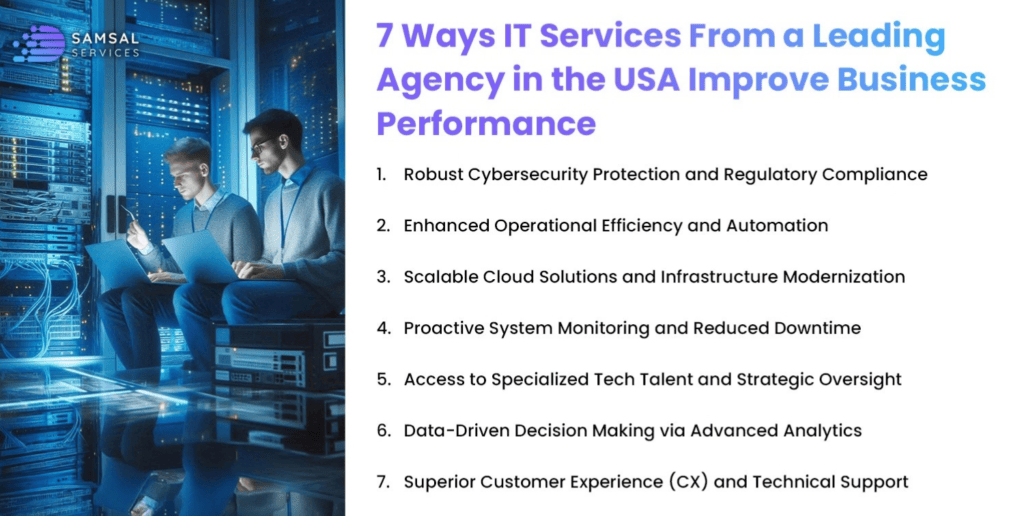
7 Ways IT Services Improve Business Performance
1. Improve Operational Efficiency Through Automation
Manual processes can consume significant amounts of employee time. Repetitive tasks such as data entry, reporting, invoice processing, customer follow-ups, and internal approvals can slow down operations and increase the possibility of human error.
Professional IT services can identify processes that are suitable for automation and implement solutions that reduce unnecessary manual work.
Automating Repetitive Business Tasks
Custom software, workflow automation, ERP systems, and business applications can connect different processes and reduce repetitive activities. For example, an automated workflow can transfer customer information between departments without requiring employees to enter the same information multiple times.
The result can be faster processes, fewer errors, and more time for employees to focus on higher-value responsibilities.
Connecting Disconnected Systems
Businesses often use multiple applications for sales, accounting, customer management, inventory, and communication. If these systems cannot communicate effectively, employees may have to move information manually.
IT integration services can connect these platforms and create a more unified technology environment.
2. Strengthen Data Security and Reduce Technology Risks
Cybersecurity is an essential part of modern business operations. Organizations handle customer information, financial records, employee data, intellectual property, and other sensitive information. A security incident can result in financial losses, operational disruption, reputational damage, and regulatory challenges.
A professional IT services provider can help businesses identify vulnerabilities and establish appropriate security measures.
Implementing Stronger Security Practices
Security services may include network protection, access controls, endpoint security, vulnerability assessments, data encryption, backup solutions, and security monitoring.
Instead of waiting for an incident to happen, businesses can take a proactive approach to identifying and addressing potential weaknesses.
Protecting Business Continuity
Data backups and disaster recovery strategies can help organizations recover important systems and information after hardware failures, cyber incidents, or other disruptions.
A well-designed recovery strategy can reduce downtime and help businesses return to normal operations more efficiently.
3. Enable Scalable Cloud Infrastructure
As businesses grow, their technology infrastructure needs to grow with them. Traditional infrastructure can sometimes make expansion expensive or difficult because companies may need additional hardware, maintenance, and technical resources.
Businesses looking for modernization can work with providers offering cloud transformation services in USA to migrate legacy workloads, modernize applications, improve infrastructure, and establish cloud environments aligned with their requirements.
Modernizing Legacy Applications
Older applications may become difficult to maintain or integrate with newer systems. Cloud transformation can involve modernizing these applications so they can operate more efficiently within contemporary technology environments. This can help organizations reduce technical limitations while creating a foundation for future digital initiatives.
Supporting Business Growth
Cloud infrastructure can make it easier for businesses to adjust resources as their needs change. This flexibility can be particularly valuable for companies experiencing seasonal demand, rapid growth, or expansion into new markets.
4. Improve Customer Experience
Customers increasingly expect businesses to provide fast, convenient, and consistent digital experiences. A slow website, difficult application, poor communication system, or complicated purchasing process can affect customer satisfaction. IT services can help organizations create better digital experiences across websites, mobile applications, customer portals, and internal systems.
Developing Customer-Focused Applications
Custom applications can be designed around specific customer requirements. Features such as account management, online ordering, appointment scheduling, personalized dashboards, and automated notifications can make interactions more convenient.
Using Data to Understand Customers
Data analytics can help businesses identify customer behavior and preferences. When organizations understand how customers interact with their products and services, they can make more informed decisions about improvements and personalization.
5. Increase Productivity With Better Digital Tools
Employees depend on technology to communicate, collaborate, access information, and complete daily responsibilities. Poorly designed systems can create unnecessary friction and reduce productivity. A professional IT partner can evaluate existing technology and recommend tools that make work easier.
Improving Collaboration
Cloud-based collaboration platforms allow teams to share files, communicate, manage projects, and work together from different locations.
This can be particularly useful for distributed teams and businesses with employees working across multiple offices or locations.
Optimizing Internal Workflows
Technology can also simplify internal processes. Digital dashboards, centralized databases, automated notifications, and integrated business applications can help employees access the information they need without switching between disconnected systems.
6. Support Better Business Decisions With Data
Business decisions are stronger when they are supported by accurate and accessible information. However, organizations often have valuable data spread across multiple systems.
IT services can help businesses collect, organize, integrate, and analyze this information.
Turning Data Into Actionable Insights
Business intelligence and analytics solutions can provide insights into sales performance, customer behavior, inventory, operational efficiency, and other important metrics.
Instead of relying entirely on assumptions, decision-makers can use data to identify trends and opportunities.
Creating Real-Time Visibility
Dashboards can bring important business metrics together in one location. Management teams can monitor performance and identify potential problems more quickly.
Better visibility can support faster responses and more informed strategic planning.
7. Reduce IT Costs and Improve Long-Term Scalability
Technology costs can increase when businesses maintain outdated infrastructure, use disconnected systems, or respond to IT problems only after they occur.
Professional IT services can help organizations create a more structured and scalable technology environment.
Reducing Unnecessary Technology Expenses
An IT assessment can identify redundant software, outdated infrastructure, inefficient processes, and systems that are no longer supporting business requirements.
Removing unnecessary technology expenses can help businesses allocate resources more effectively.
Building for Future Growth
Scalability should be considered when developing or upgrading technology. A solution that works for a small organization may not be suitable when the company doubles its customers or employees.
An experienced IT partner can design infrastructure and applications with future requirements in mind, reducing the need for frequent major technology replacements.
How to Choose a Leading IT Services Agency in the USA
Choosing an IT provider is an important business decision. Companies should evaluate potential partners based on more than technical capabilities.
Evaluate Industry Experience
Look for an agency that understands your industry, business model, and technology requirements. Relevant experience can help an IT provider understand common challenges and develop solutions that fit the organization.
Review the Range of IT Services
A provider offering multiple capabilities can potentially support different stages of a company’s digital journey. Depending on business requirements, services may include software development, cloud solutions, cybersecurity, IT consulting, application modernization, data analytics, infrastructure management, and digital transformation.
Consider Scalability and Support
Technology requirements change over time. Ask how the provider handles future expansion, system upgrades, technical support, security monitoring, and ongoing maintenance.
A long-term IT partner should be capable of supporting the organization beyond the initial implementation.
The Role of IT Services in Digital Transformation
Digital transformation involves more than introducing new software. It is about using technology to improve how a business operates, serves customers, manages information, and creates value.
An experienced IT services agency can help organizations assess existing systems and develop a practical transformation roadmap.
Modernizing Existing Technology
Organizations do not always need to replace every system. In many cases, modernization can improve existing applications and infrastructure while preserving valuable business processes.
This can involve cloud migration, API integration, application modernization, automation, or database improvements.
Creating a Technology Roadmap
A technology roadmap provides a structured approach to future IT investments. It can identify priorities, timelines, dependencies, and expected business outcomes.
This helps organizations avoid disconnected technology projects and focus resources on initiatives that support broader business objectives.
Why a Strategic IT Partnership Matters
Technology projects can become complicated when business objectives and technical implementation are not aligned. A strategic IT partner bridges this gap by connecting business requirements with practical technology solutions. A Leading IT Services Agency in the USA can support businesses throughout planning, development, implementation, optimization, and ongoing maintenance.
The goal is not simply to introduce more technology. It is to make technology work more effectively for the organization.
Frequently Asked Questions
1. What does an IT services agency do for a business?
An IT services agency provides technology expertise and solutions that can support business operations. Services may include software development, cloud computing, cybersecurity, IT consulting, system integration, infrastructure management, data analytics, and application modernization.
2. How can IT services improve business performance?
IT services can improve performance by automating repetitive tasks, reducing downtime, strengthening security, improving customer experiences, increasing employee productivity, supporting data-driven decisions, and creating scalable technology infrastructure.
3. What are cloud transformation services in USA?
Cloud transformation services in USA help businesses modernize their technology environments by migrating applications and infrastructure to the cloud, modernizing legacy systems, improving cloud architecture, and optimizing cloud operations.
4. How do I choose the right IT services agency?
Consider the agency’s technical expertise, industry experience, service range, security practices, scalability, support model, project methodology, and ability to understand your specific business objectives. It is also useful to review relevant case studies and previous projects before making a decision.
Conclusion
Technology can directly influence how efficiently a business operates, how effectively it serves customers, and how prepared it is for future growth. From automating repetitive processes and improving cybersecurity to modernizing applications and enabling cloud infrastructure, professional IT services can address many of the challenges businesses face today.
Working with a leading IT Services Agency in the USA can provide access to specialized expertise and scalable technology solutions without requiring organizations to manage every technical capability internally.
Whether a company needs application development, infrastructure modernization, cybersecurity, analytics, or cloud transformation services in USA, the right IT partner can help connect technology investments with measurable business objectives.