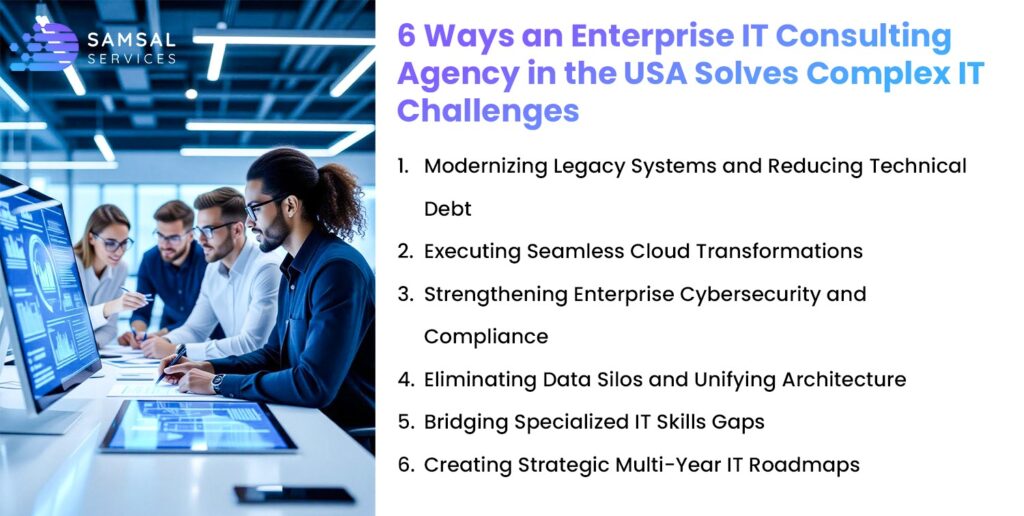
Modern businesses depend heavily on technology to manage operations, serve customers, protect data, and stay competitive. However, as organizations grow, their IT environments often become more complex. Legacy systems, disconnected applications, cybersecurity risks, cloud migration challenges, and increasing operational costs can create serious obstacles.
This is where an Enterprise IT consulting Agency in the USA can provide strategic value. Instead of simply fixing technical problems as they occur, an experienced IT consulting agency helps businesses identify the root causes of their technology challenges and develop long-term solutions.
Enterprise IT consulting combines technology expertise with business strategy. Consultants analyze existing infrastructure, applications, workflows, and security systems to create an IT roadmap that supports business goals.
1. Developing a Clear IT Strategy for Business Growth
One of the biggest challenges businesses face is using technology without a clear long-term strategy. Many organizations invest in software, cloud platforms, and digital tools over time without considering how those technologies will work together.
As a result, businesses may end up with disconnected systems, duplicated processes, unnecessary expenses, and technology that does not fully support their goals.
Aligning Technology With Business Objectives
An Enterprise IT consulting Agency in the USA begins by understanding the business itself. Consultants evaluate the organization’s goals, operational challenges, current technology environment, and future requirements.
The objective is to ensure that technology investments support measurable business outcomes.
For example, a growing company may need to improve customer service, automate manual processes, or expand into new markets. Instead of recommending random software solutions, IT consultants can create a technology strategy designed around those specific goals.
Creating a Long-Term Technology Roadmap
A strong IT roadmap helps businesses understand what technology improvements should happen and when. It can include:
- Infrastructure modernization
- Cloud migration planning
- Application upgrades
- Cybersecurity improvements
- Data management strategies
- Technology investment priorities
This structured approach helps businesses avoid making reactive technology decisions. Instead, they can build scalable systems that support long-term growth.
An effective Enterprise IT consulting Agency in the USA helps organizations move from short-term problem-solving to strategic technology planning.
2. Modernizing Legacy Systems and IT Infrastructure
Many established businesses still depend on legacy systems that were developed years ago. While these systems may continue to perform basic functions, they can become expensive, difficult to maintain, and incompatible with modern technologies. Legacy infrastructure can also slow down innovation and create security risks.
Identifying Infrastructure Limitations
Before modernization begins, IT consultants analyze the existing technology environment. This includes servers, applications, databases, networks, and integrations.
The goal is to identify areas that create operational challenges.
For example, an outdated application may require excessive maintenance, while an older server environment may limit scalability. Consultants help businesses understand which systems should be upgraded, replaced, integrated, or migrated.
Planning a Smooth Modernization Process
Technology modernization does not always require replacing everything at once. A professional consulting strategy focuses on reducing risk and minimizing business disruption.
Consultants can recommend a phased modernization approach that allows businesses to improve systems gradually.
This may include moving specific workloads to the cloud, upgrading critical applications, improving integrations, or adopting modern software solutions.
By working with an Enterprise IT consulting Agency in the USA, organizations can modernize their infrastructure with a structured plan rather than making costly and disruptive technology changes.
Supporting Digital Transformation
Modernization is also an important part of digital transformation. Businesses need flexible technology systems that can adapt to changing customer expectations and market conditions.
Modern infrastructure can improve performance, scalability, collaboration, and data accessibility.
It also creates a stronger foundation for technologies such as artificial intelligence, automation, cloud computing, and advanced analytics.
3. Strengthening Cybersecurity and Reducing Technology Risks
Cybersecurity has become one of the most important concerns for modern businesses. Organizations of all sizes face threats such as ransomware, phishing attacks, data breaches, and unauthorized system access.
As technology environments become more complex, managing cybersecurity internally can become increasingly difficult.
Assessing Security Vulnerabilities
An Enterprise IT consulting Agency in the USA can perform a detailed security assessment to identify potential weaknesses.
Consultants may review:
Network security
User access controls
Data protection
Cloud security
Software vulnerabilities
Backup systems
Security policies
Incident response procedures
This assessment helps businesses understand where potential risks exist before they become serious problems.
Building a Stronger Security Framework
After identifying vulnerabilities, IT consultants can recommend improvements based on the organization’s technology environment and business requirements.
Security improvements may include stronger authentication systems, better access management, regular security monitoring, data encryption, and employee awareness programs.
The goal is not simply to install more security tools. Instead, businesses need a complete security strategy that protects systems, data, employees, and customers.
Improving Business Continuity
Cybersecurity planning should also include business continuity. Even with strong security systems, businesses should be prepared for unexpected events.
IT consultants can help organizations develop backup and disaster recovery strategies that reduce downtime and protect critical information.
This allows businesses to recover more quickly from cyber incidents, system failures, or other technology disruptions.
4. Improving Operational Efficiency Through Technology
Many businesses still rely on manual processes that consume valuable time and resources. Employees may need to enter the same information into multiple systems, manage spreadsheets, or complete repetitive administrative tasks.
These processes can reduce productivity and increase the risk of human error.
Identifying Inefficient Workflows
An Enterprise IT consulting Agency in the USA evaluates how technology is currently being used across the organization.
Consultants analyze workflows to identify unnecessary steps, disconnected systems, and repetitive tasks.
For example, a business may have separate systems for sales, inventory, customer information, and financial reporting. If these platforms do not communicate effectively, employees may spend significant time transferring information manually.
Implementing Automation Solutions
Automation can help businesses improve efficiency by reducing repetitive tasks.
IT consultants can recommend automation solutions for processes such as:
Data entry
Customer communication
Reporting
Inventory management
Employee workflows
System monitoring
Automation allows employees to focus more on strategic and customer-focused activities.
Improving System Integration
System integration is another important part of improving operational efficiency. Businesses often use multiple software platforms, but disconnected applications can create information gaps.
Consultants help organizations connect systems so information can move more efficiently between departments.
For example, integrating customer relationship management platforms with sales, marketing, and customer service systems can provide teams with better access to customer information.
This creates more efficient workflows and supports better decision-making.
5. Managing Cloud Migration and Technology Scalability
Cloud technology has changed how businesses manage infrastructure, applications, and data. However, moving to the cloud can be complex without the right strategy.
Businesses must decide which applications and workloads should move, which cloud environment is appropriate, and how to manage security and costs.
Creating a Cloud Migration Strategy
An Enterprise IT consulting Agency in the USA helps businesses create a structured cloud migration plan.
Consultants analyze existing systems and determine which workloads are suitable for cloud migration.
The strategy may include different approaches, such as:
Rehosting existing applications
Modernizing applications
Moving selected workloads
Developing cloud-native solutions
Using hybrid cloud environments
The right approach depends on the organization’s infrastructure, budget, performance requirements, and long-term goals.
Reducing Cloud Migration Risks
Cloud migration can create challenges if it is not properly planned. Data loss, downtime, compatibility problems, and unexpected costs can affect business operations.
IT consultants help reduce these risks by creating detailed migration plans, testing systems, and monitoring performance throughout the process.
A phased approach can also help organizations move workloads gradually while maintaining operational continuity.
Building Scalable Technology Systems
One of the biggest advantages of modern cloud environments is scalability. Businesses can adjust technology resources based on demand.
This is especially valuable for organizations experiencing rapid growth or seasonal changes.
A consulting agency helps businesses design technology environments that can scale without requiring major infrastructure investments every time the organization grows.
6. Providing Data-Driven Insights for Better Decision-Making
Modern businesses generate large amounts of data every day. Customer interactions, sales transactions, website activity, operational systems, and marketing platforms all produce valuable information.
However, collecting data is not enough. Businesses need the ability to organize, analyze, and use that information effectively.
Creating Better Data Management Systems
An Enterprise IT consulting Agency in the USA helps businesses improve how data is collected, stored, and managed.
Consultants can help organizations create centralized data systems that reduce duplication and improve accessibility.
Better data management allows teams to access reliable information when they need it.
This can improve decision-making across departments and reduce the confusion caused by inconsistent or outdated information.
Using Analytics to Identify Opportunities
Data analytics can help businesses understand important patterns and trends.
Organizations can analyze:
Customer behavior
Sales performance
Product performance
Financial information
These insights can help business leaders make more informed decisions.
For example, analyzing customer behavior can help companies improve their services, while operational data can reveal areas where costs or delays can be reduced.
Preparing for AI and Emerging Technologies
Well-organized data is also essential for adopting emerging technologies.
Artificial intelligence and automation tools depend on accurate and accessible data. Businesses with disconnected or poorly managed data systems may struggle to take advantage of these technologies.
An experienced consulting partner can help organizations create the technical foundation required for future innovation.
Why Businesses Need an Enterprise IT Consulting Agency in the USA
Technology is no longer simply a support function. It plays a direct role in customer experience, operational efficiency, security, and business growth.
However, managing complex IT environments requires specialized expertise.
Working with an Enterprise IT consulting Agency in the USA gives businesses access to strategic guidance and technical knowledge without relying entirely on internal resources.
A consulting agency can provide an objective view of the organization’s technology environment and identify challenges that internal teams may overlook.
The right IT consulting partner can help businesses:
Develop a clear IT strategy
Modernize outdated systems
Improve cybersecurity
Automate business processes
Manage cloud transformation
Improve data management
Reduce technology costs
Build scalable infrastructure
Instead of reacting to technology problems, businesses can create a proactive strategy that supports long-term success.
Choosing the Right IT Consulting Partner
Not every consulting agency offers the same level of expertise or approach. Businesses should look for a consulting partner that understands both technology and business operations.
Scalability and Long-Term Support
Business technology needs can change quickly. The right consulting partner should provide solutions that can adapt as the organization grows.
Long-term support and ongoing optimization can also help businesses continue improving their technology environment.
How Enterprise IT Consulting Supports Digital Transformation
Digital transformation requires more than adopting new technology. Businesses must also rethink processes, systems, and how teams use information.
An Enterprise IT consulting Agency in the USA can guide organizations through this process by creating a clear transformation strategy.
Consultants can evaluate current technology maturity, identify improvement opportunities, and prioritize projects based on business impact.
This approach helps organizations avoid investing in technology simply because it is popular.
Instead, they can focus on solutions that solve real business challenges.
Digital transformation can include cloud adoption, application modernization, automation, improved data management, and enhanced customer experiences.
When these initiatives are connected through a clear strategy, businesses can create stronger and more flexible operations.
The Long-Term Value of Enterprise IT Consulting
The value of IT consulting extends beyond solving immediate technology problems.
A strong consulting relationship helps businesses continuously evaluate and improve their technology environment.
As customer expectations, cybersecurity risks, and market conditions change, organizations need technology systems that can adapt.
Enterprise IT consultants can help businesses stay prepared for these changes.
They can monitor technology trends, recommend improvements, and identify opportunities for innovation.
This proactive approach can reduce future technology risks and help businesses make smarter investments.
Rather than treating IT as an operational expense, businesses can use technology as a strategic asset that supports growth and competitive advantage.
Frequently Asked Questions
1. What does an Enterprise IT consulting Agency in the USA do?
An Enterprise IT consulting Agency in the USA helps businesses solve complex technology challenges through strategic planning, infrastructure modernization, cybersecurity, cloud migration, automation, data management, and digital transformation services.
2. How can IT consulting help businesses reduce costs?
IT consulting helps businesses identify unnecessary technology expenses, optimize infrastructure, automate manual processes, improve system efficiency, and make better technology investment decisions. This can reduce operational costs over time.
3. Is enterprise IT consulting only for large companies?
No. While enterprise IT consulting is valuable for large organizations with complex technology environments, growing businesses can also benefit from strategic IT guidance. Consulting services can be adapted based on business size and technology requirements.
4. How does IT consulting support digital transformation?
IT consultants assess existing systems, identify technology gaps, create transformation strategies, and guide businesses through modernization initiatives. This can include cloud adoption, automation, application upgrades, data improvements, and cybersecurity enhancements.
Conclusion
Complex IT challenges can limit business growth, increase operational costs, and create security risks. From outdated infrastructure and disconnected systems to cloud migration and data management, businesses need a strategic approach to managing technology.
An Enterprise IT consulting Agency in the USA helps organizations overcome these challenges by combining technical expertise with business-focused strategy. Through IT planning, infrastructure modernization, cybersecurity improvements, automation, cloud solutions, and data-driven decision-making, businesses can build a stronger technology foundation.