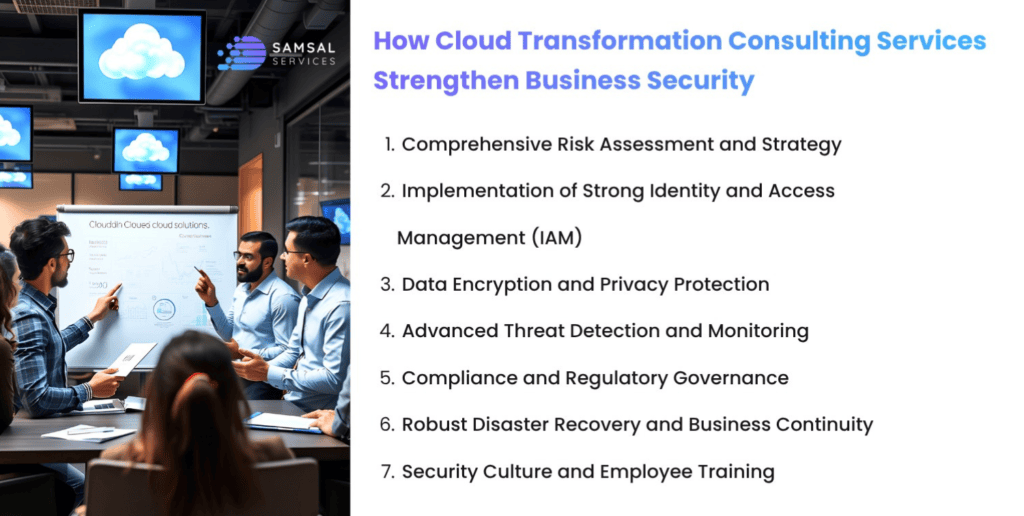
Business security has become a major priority as organizations increasingly depend on digital platforms, cloud applications, and online infrastructure to manage their daily operations. From customer information and financial records to internal business applications, companies handle large amounts of sensitive data that require reliable protection.
Cloud technology offers businesses new opportunities to improve security, manage data more efficiently, and maintain reliable IT infrastructure. However, moving business operations to the cloud requires more than transferring files and applications.
This is where Cloud Transformation Consulting Services become valuable. These services help businesses evaluate their existing IT environments, adopt secure cloud platforms, and implement security strategies that support long-term growth. With the right consulting approach, organizations can build a flexible infrastructure while reducing potential security vulnerabilities.
1. Strengthening Data Protection Through Advanced Cloud Security
Data is one of the most valuable assets for any organization. Losing access to important business information or exposing confidential customer records can create financial losses, operational disruptions, and reputational damage.
Cloud transformation helps businesses implement advanced data protection methods that reduce these risks.
Implementing Data Encryption
Encryption is an essential part of cloud security. It converts readable information into an encrypted format that unauthorized users cannot easily understand. Businesses can use encryption to protect sensitive information both when it is stored and when it moves between systems.
Cloud providers offer encryption capabilities that help organizations protect databases, files, backups, and application communications. Consulting specialists can help select appropriate encryption methods and configure them according to business requirements.
For example, an ecommerce company handling customer information and online transactions can use encryption to protect sensitive records from unauthorized access.
Protecting Business Information Across Cloud Environments
Organizations often store information across multiple platforms, applications, and cloud environments. Without proper security management, these distributed systems can create additional risks.
Cloud transformation consultants help establish consistent data protection policies across different environments. They identify sensitive information, recommend secure storage solutions, and implement appropriate access restrictions.
2. Improving Access Control and Identity Management
Not every employee, contractor, or third-party partner needs access to every business resource. Giving users unnecessary permissions can increase the risk of accidental data exposure and unauthorized activities.
Cloud transformation allows organizations to introduce centralized identity and access management systems that provide better control over who can access specific resources.
Implementing Role-Based Access Control
Role-Based Access Control (RBAC) allows businesses to assign permissions according to an employee’s responsibilities. Instead of providing unrestricted access, organizations can limit permissions to the information and applications required for specific roles.
For example, an accounting employee may need access to financial applications but should not automatically have permission to view development environments or sensitive customer databases.
Using Multi-Factor Authentication
Passwords alone are not always enough to protect business accounts. Weak passwords, phishing attacks, and stolen login credentials can allow unauthorized users to access important systems.
Multi-Factor Authentication (MFA) adds another verification step before granting access. Users may need to confirm their identity through an authentication application, security key, or another approved verification method.
Cloud transformation specialists can help implement MFA across business applications, administrative accounts, and remote access systems.
3. Strengthening Cybersecurity With Continuous Threat Monitoring
Cyberattacks are becoming more sophisticated, making it important for businesses to identify suspicious activities before they cause significant damage. Traditional security systems that depend only on periodic checks may not provide sufficient visibility into modern cloud environments.
Cloud infrastructure supports continuous monitoring and security analytics that help organizations identify potential threats more effectively.
Detecting Suspicious Activities in Real Time
Cloud monitoring tools can analyze system activity, network traffic, login attempts, and application behavior. They help security teams recognize unusual patterns that may indicate unauthorized access or malicious activity.
For instance, repeated login attempts from unfamiliar locations or unexpected changes to sensitive files may indicate a potential security incident.
Using AI-Powered Security Solutions
Artificial intelligence and machine learning are increasingly being used to improve cybersecurity. These technologies can analyze large amounts of system data, identify unusual behavior, and support faster threat detection.
AI-powered security tools can help businesses prioritize potential risks and investigate suspicious activities. However, they should work alongside human security professionals rather than replace proper security management.
4. Reducing Security Vulnerabilities Through Regular Updates
Outdated software, unsupported applications, and unpatched operating systems can create security weaknesses that attackers may exploit. Businesses operating legacy IT infrastructure often struggle to maintain consistent updates across multiple systems.
Cloud transformation provides an opportunity to modernize applications and establish better maintenance practices.
Keeping Cloud Infrastructure Updated
Cloud platforms provide managed services and tools that can simplify infrastructure maintenance. Depending on the selected service model, cloud providers may manage certain infrastructure updates, while businesses remain responsible for operating systems, applications, configurations, and other components.
Cloud consultants help organizations understand these responsibilities and develop a suitable patch management strategy.
Identifying and Fixing Security Weaknesses
Security assessments are important before and after cloud migration. They help businesses identify outdated components, misconfigured services, unnecessary permissions, and other vulnerabilities.
Consultants can recommend vulnerability scanning, configuration reviews, and penetration testing based on the organization’s security requirements.
By addressing these weaknesses systematically, businesses can maintain a more reliable infrastructure and reduce the likelihood of preventable security incidents.
5. Improving Business Continuity With Cloud Backup and Disaster Recovery
Unexpected events such as ransomware attacks, hardware failures, accidental deletion, and natural disasters can interrupt business operations. Without reliable backup and recovery procedures, organizations may lose important information and experience extended downtime.
Cloud transformation helps businesses develop more flexible backup and disaster recovery strategies.
Creating Secure Cloud Backups
Cloud backup solutions allow organizations to maintain copies of important business information in secure storage environments. Automated backup schedules can reduce dependence on manual processes and help ensure that essential data is regularly protected.
Businesses can also use access restrictions, encryption, and immutable backup storage to improve protection against unauthorized changes and ransomware-related deletion.
Consultants help determine backup frequency, storage requirements, retention periods, and recovery priorities according to business needs.
Establishing Disaster Recovery Plans
A disaster recovery plan explains how an organization will restore its systems and data after a major disruption.
Cloud-based disaster recovery solutions can help businesses restore applications, databases, and important services without depending entirely on physical infrastructure.
Consulting specialists help establish recovery objectives, including:
- Recovery Time Objective (RTO): The maximum acceptable time required to restore a system or service.
- Recovery Point Objective (RPO): The maximum acceptable amount of data loss measured in time.
By defining these objectives and regularly testing recovery procedures, organizations can improve operational resilience and maintain business continuity.
6. Supporting Regulatory Compliance and Security Standards
Businesses operating in regulated industries must follow specific requirements for handling, storing, and protecting sensitive information. Healthcare, financial services, ecommerce, and other industries may have different legal and regulatory responsibilities.
Cloud transformation can help organizations establish security controls that support compliance requirements.
Maintaining Data Privacy and Governance
Data governance involves managing how business information is collected, stored, accessed, processed, and retained.
Cloud consultants help organizations develop appropriate policies for data classification, retention, access permissions, and information handling.
They can also help identify suitable cloud services based on industry requirements and the locations where business data must be stored.
Supporting Industry Compliance Requirements
Depending on the organization’s operations and location, relevant requirements may include GDPR, HIPAA, PCI DSS, and other industry-specific or regional regulations.
Cloud providers may offer infrastructure and services that support certain compliance requirements, but using a compliant cloud provider does not automatically make a business compliant.
Organizations must also configure their systems correctly, manage user access, maintain appropriate documentation, and follow their own regulatory responsibilities.
7. Building a Scalable and Secure IT Infrastructure
As businesses grow, their technology requirements change. They may need additional storage, more computing resources, new applications, and support for remote employees. Expanding traditional infrastructure can become expensive and difficult to manage.
Cloud transformation allows organizations to scale their IT environments while maintaining consistent security practices.
Adopting Secure Cloud Architecture
A secure cloud architecture provides a structured foundation for managing applications, networks, databases, and business information.
Consultants help businesses design environments using security principles such as network segmentation, least-privilege access, secure configurations, and centralized monitoring.
They may also recommend separating development, testing, and production environments to reduce the risk of unauthorized changes affecting live business operations.
Supporting Hybrid and Multi-Cloud Environments
Some organizations prefer to use a combination of private cloud, public cloud, and on-premises infrastructure. Others distribute workloads across multiple cloud providers to meet specific operational requirements.
Professional consulting helps businesses establish consistent security policies, manage different cloud environments, and maintain visibility across their infrastructure.
Working with a Leading IT Services Agency in the USA can help organizations develop cloud strategies that balance performance, scalability, security, and long-term business objectives.
How to Choose the Right Cloud Transformation Consulting Partner
Selecting the right consulting partner is an important decision because cloud transformation can affect nearly every part of an organization’s IT operations.
Businesses should evaluate potential partners based on their technical capabilities, security expertise, and experience with similar projects.
Evaluate Technical and Cybersecurity Expertise
Look for consultants with practical experience in cloud migration, infrastructure modernization, identity management, data protection, and cybersecurity.
They should understand major cloud platforms such as Amazon Web Services (AWS), Microsoft Azure, and Google Cloud.
A capable partner should also be able to assess existing infrastructure and recommend solutions based on actual business requirements rather than unnecessary technology upgrades.
Understand Their Cloud Migration Strategy
A reliable consulting partner should provide a clear migration roadmap. This includes evaluating existing systems, identifying dependencies, prioritizing workloads, and planning security controls before migration begins.
The strategy should also explain how downtime, data integrity, testing, and post-migration monitoring will be managed.
Prioritize Long-Term Security Support
Cloud security is not a one-time implementation. New vulnerabilities, changing business requirements, and emerging cyber threats require continuous attention.
Choose a partner that can support ongoing security assessments, infrastructure optimization, monitoring, and system improvements.
A long-term consulting relationship helps businesses maintain a secure and scalable cloud environment as their operations evolve.
Frequently Asked Questions (FAQs)
1. What Are Cloud Transformation Consulting Services?
Cloud Transformation Consulting Services help businesses plan, implement, and manage the transition from traditional IT infrastructure to modern cloud-based environments. These services include cloud migration, infrastructure modernization, cybersecurity planning, data protection, and performance optimization.
2. How Does Cloud Transformation Improve Business Security?
Cloud transformation improves business security through encryption, identity and access management, continuous monitoring, automated updates, and secure backup solutions. It also helps organizations implement centralized security policies and identify potential vulnerabilities.
3. Is Cloud Transformation Suitable for Small Businesses?
Yes, cloud transformation can benefit small businesses by providing access to scalable infrastructure and advanced security tools without requiring significant investments in physical servers.The right solution depends on business requirements, budget, and security priorities.
4. How Long Does a Cloud Transformation Project Take?
The timeline depends on the size of the organization, the complexity of its existing infrastructure, the number of applications being migrated, and its security requirements. A small cloud migration may take several weeks, while larger enterprise transformation projects can require several months or longer.
Conclusion
Business security is no longer limited to installing antivirus software or maintaining traditional network protection. Organizations need a comprehensive approach that protects sensitive information, manages user access, identifies cyber threats, and supports uninterrupted operations.
Cloud Transformation Consulting Services help businesses achieve these objectives by modernizing IT infrastructure and introducing advanced security practices. From data encryption and identity management to continuous monitoring, regulatory compliance, and disaster recovery, cloud transformation provides organizations with the tools needed to build a stronger security foundation.
However, successful transformation requires careful planning, technical expertise, and continuous management. Businesses should work with experienced IT professionals who understand their infrastructure, security challenges, and long-term objectives.