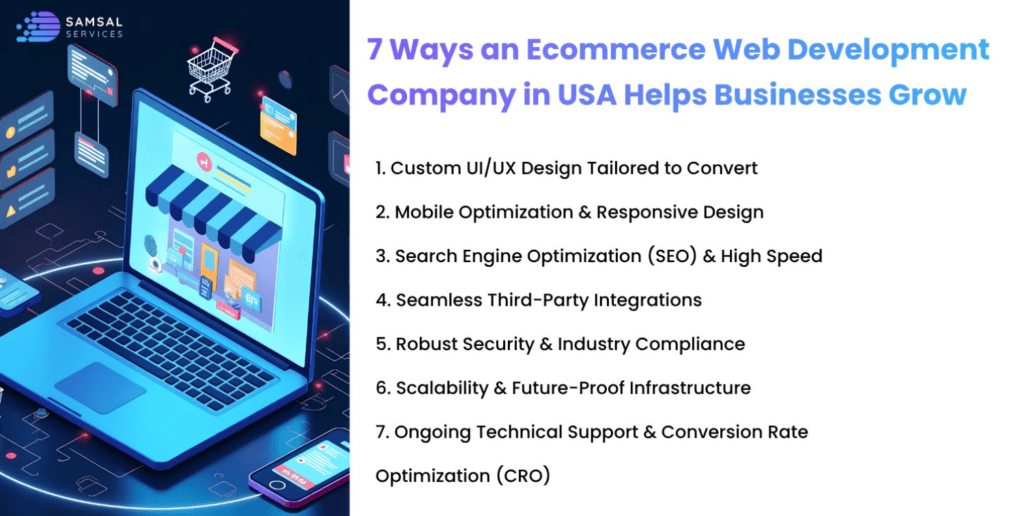
Ecommerce success depends on a fast, secure, and user-friendly website that makes online shopping simple. An experienced Ecommerce Web Development Company in USA helps businesses build scalable online stores with seamless navigation, secure payments, mobile responsiveness, and SEO-friendly design.
By integrating AI Automation Services for Businesses in USA, companies can also streamline order management, improve customer support, and deliver personalized shopping experiences. These solutions help businesses strengthen their online presence, improve operational efficiency, and support long-term growth.
1. Builds a Professional and User-Friendly Ecommerce Website
A professional ecommerce website creates the first impression of a business. Customers often evaluate a brand based on its website design, product presentation, navigation, and overall usability. A confusing or outdated website can reduce customer confidence, even when the products are high quality.
An experienced ecommerce development company focuses on creating a website that reflects the brand’s identity while making shopping simple and convenient.
Creates an Intuitive Shopping Experience
Customers should be able to find products, compare options, and complete purchases without unnecessary steps. Clear navigation menus, organized product categories, effective search functionality, and straightforward checkout processes make shopping easier.
Professional developers also consider the complete customer journey, from the moment a visitor lands on the homepage to the final purchase confirmation. Each page should guide users toward relevant products and purchasing decisions.
For example, a clothing retailer may need filters for size, color, brand, and price. A wholesale supplier may require bulk ordering, customer-specific pricing, and account-based purchasing features. Customizing the shopping experience around the target audience makes the website more useful.
Strengthens Brand Identity
Consistent colors, typography, product photography, and visual elements help establish a recognizable brand. A professional website should communicate the company’s value proposition and differentiate it from competitors.
An Ecommerce Web Development Company in USA can create a consistent design across product pages, category pages, promotional banners, and checkout screens. This consistency helps customers understand the brand and navigate the website with greater confidence.
2. Improves Website Speed and Mobile Responsiveness
Website performance directly affects the shopping experience. Customers may abandon a store when pages load slowly, product images fail to display, or checkout takes too long.
A fast, responsive website helps businesses provide a smoother experience and reduces technical barriers that prevent visitors from completing purchases.
Optimizes Loading Speed
Website speed depends on several technical factors, including image sizes, hosting infrastructure, scripts, caching, and code quality. Ecommerce websites can become particularly slow when they contain large product catalogs, third-party applications, or complex features.
Professional developers can improve performance by compressing images, minimizing unnecessary scripts, implementing caching, and optimizing database queries. They can also evaluate hosting resources and content delivery networks when appropriate.
Delivers a Consistent Mobile Experience
Many customers browse products and make purchases through smartphones. A website that works well on desktop but performs poorly on mobile devices can miss important sales opportunities.
Responsive design ensures that product images, navigation menus, forms, buttons, and checkout pages adapt to different screen sizes. Mobile users should be able to view product details, select variations, add items to their carts, and complete payments comfortably.
3. Develop Secure and Reliable Payment Systems
Security is a fundamental requirement for ecommerce businesses. Customers need confidence that their personal information and payment details are handled responsibly.
A secure website protects business operations, supports customer trust, and reduces the risk of preventable security incidents.
Integrate Trusted Payment Gateways
An ecommerce website may support credit cards, debit cards, digital wallets, and other payment methods depending on the target market. Developers integrate suitable payment gateways to help customers complete transactions conveniently. The right payment solution should offer reliable processing, appropriate fraud-prevention features, and compatibility with the business’s ecommerce platform.
Businesses should also ensure that payment processing follows applicable security requirements. Using established payment providers and avoiding unnecessary storage of sensitive payment information can help reduce risk.
Protects Customer and Business Data
Security measures may include SSL/TLS encryption, secure authentication, access controls, software updates, regular backups, and continuous monitoring. Developers should also review third-party extensions and integrations because outdated or poorly maintained components can introduce vulnerabilities.
For businesses operating in the USA, applicable privacy, consumer protection, and payment security requirements should be considered during development. The specific obligations depend on the business model, customer locations, and types of information collected.
4. Strengthens Ecommerce SEO and Organic Visibility
A well-designed ecommerce website needs visibility to attract potential customers. Search engine optimization helps product pages, category pages, and informational content appear for relevant searches.
Working with an Ecommerce Web Development Company in USA that understands technical SEO can help businesses establish a stronger foundation for organic growth.
Creates an SEO-Friendly Website Structure
Search engines need to discover, crawl, and understand website content. A logical structure makes it easier for search engines and visitors to navigate the store.
Developers can implement descriptive URLs, clear internal linking, XML sitemaps, appropriate canonical tags, and well-organized category pages. They can also address duplicate content, broken links, redirect issues, and crawlability problems.
For example, an online electronics store might organize its website into categories such as laptops, accessories, monitors, and networking equipment. Each category can contain relevant product pages and useful supporting content.
Optimizes Product and Category Pages
Product pages should provide accurate descriptions, useful specifications, high-quality images, pricing information, and clear calls to action. Unique content helps customers understand the product and gives search engines more meaningful information.
Relevant keywords should be included naturally in page titles, headings, descriptions, and other appropriate elements. Structured data may also help eligible pages qualify for enhanced search results when they meet search engine guidelines.
Technical SEO should be supported by useful content, internal linking, and a good user experience. Rankings are never guaranteed, but a technically sound website gives businesses a stronger platform for their SEO efforts.
5. Integrates AI Automation to Improve Ecommerce Operations
Ecommerce businesses often manage large volumes of customer inquiries, orders, inventory updates, product information, and marketing activities. Handling every task manually can increase operating costs and slow down service.
AI and workflow automation can help businesses manage repetitive activities, improve responsiveness, and make better use of operational data.
Automates Customer Support
AI-powered chatbots and virtual assistants can answer common questions about shipping policies, order status, product availability, returns, and store policies. These tools can provide support outside regular business hours and direct more complex requests to human employees. Their effectiveness depends on the quality of the underlying information, integration with business systems, and the availability of human escalation.
For example, an online retailer can connect its support assistant to approved order information so customers can receive relevant updates without contacting a support representative for every routine question.
Streamlines Inventory and Order Management
Automation can connect an ecommerce store with inventory systems, accounting software, shipping providers, and customer relationship management platforms. Depending on the setup, these integrations can synchronize stock levels, generate order notifications, update tracking information, and trigger low-stock alerts.
Businesses exploring AI Automation Services for Businesses in USA can also consider AI-assisted demand forecasting, customer segmentation, and product recommendations. These capabilities may help identify purchasing patterns and support more informed business decisions.
6. Supports Scalability and Custom Ecommerce Functionality
A business’s website requirements often change as the company grows. A store that initially serves a small customer base may eventually need thousands of product listings, multiple sales channels, advanced reporting, or international shipping options. A scalable ecommerce website makes it easier to accommodate these changes without rebuilding the entire platform.
Develop Features Around Business Requirements
Every ecommerce business has different operational needs. A standard retail store may require product variations, discount codes, and customer reviews, while a B2B supplier may need bulk ordering, negotiated pricing, minimum order quantities, and customer-specific catalogs.
A professional development team evaluates these requirements before recommending a platform or custom solution.
Depending on the project, useful features may include:
- Advanced product filtering and search.
- Customer accounts and order history.
- Bulk ordering and wholesale pricing.
- Subscription and recurring payment options.
- Multi-currency and shipping integrations.
- Inventory synchronization and sales reporting.
The objective is to implement functionality that solves real business problems rather than adding unnecessary complexity.
Plans for Future Growth
Scalability involves more than supporting additional website traffic. It also includes maintaining performance, integrating new tools, managing larger product catalogs, and supporting changing business processes.
Developers may recommend a hosted ecommerce platform, a customized platform implementation, or a more specialized architecture based on the company’s budget and technical requirements.
A suitable solution should balance flexibility, maintenance costs, security, and ease of use. Businesses should also consider how easily employees can manage products, update content, process orders, and review sales data without relying on developers for every routine change.
7. Use Analytics and Conversion Optimization to Increase Sales
Website traffic is valuable, but traffic alone does not determine ecommerce success. Businesses need to understand how visitors interact with their websites, where they encounter difficulties, and which activities contribute to sales. Analytics and conversion optimization help identify opportunities to improve the customer journey.
Tracks Important Ecommerce Metrics
A properly configured analytics system can provide insights into product views, cart additions, checkout activity, purchases, revenue, and traffic sources. Businesses can use these insights to identify high-performing products, evaluate marketing campaigns, and investigate pages where visitors frequently leave.
For example, if a product receives substantial traffic but few purchases, the business might review its price, product description, delivery information, customer reviews, or page usability.
Improves the Checkout and Purchase Journey
A complicated checkout process can discourage customers from completing orders. Unnecessary form fields, unexpected shipping costs, limited payment options, and unclear return policies can create friction. Developers can simplify checkout steps, improve form validation, display delivery information clearly, and provide convenient payment methods.
Businesses can also test different page layouts, calls to action, product images, and promotional messages. A/B testing, when implemented correctly, helps compare alternatives using actual user behavior instead of relying entirely on assumptions.
How to Choose the Right Ecommerce Web Development Company in USA
Selecting the right development partner is an important decision because the quality of the website can affect business operations for years. Before choosing a company, evaluate its experience with ecommerce platforms, custom integrations, responsive design, technical SEO, and website security. Review relevant portfolio projects to understand whether the team has worked on websites with requirements similar to yours.
It is also important to discuss project scope, estimated timelines, pricing, maintenance arrangements, and post-launch support. A reliable provider should explain its recommendations clearly and establish realistic expectations instead of promising guaranteed rankings or sales.
Ask how the company approaches website performance, data protection, analytics, and future scalability. If automation is part of your growth strategy, confirm whether the team can integrate suitable AI tools and existing business systems.
Frequently Asked Questions
1. What Does an Ecommerce Web Development Company in USA Do?
An ecommerce web development company designs, develops, tests, and maintains online stores. Its services may include website design, product catalog setup, shopping cart development, payment gateway integration, mobile responsiveness, technical SEO, security improvements, and third-party system integrations.
2. How Much Does Ecommerce Website Development Cost in the USA?
A basic store using an established platform generally costs less than a custom ecommerce solution with advanced inventory management, B2B pricing, or specialized integrations. Ongoing expenses may include hosting, platform subscriptions, payment processing, maintenance, and marketing.
3. Can AI Automation Improve Ecommerce Business Performance?
The benefits depend on implementation quality, data accuracy, integration capabilities, and the processes being automated. Businesses should begin with clear use cases, measure the results, and retain human oversight for sensitive or complex decisions.
4. How Long Does It Take to Develop an Ecommerce Website?
The development timeline depends on the project’s size and complexity. A relatively simple store built on an established platform may take several weeks, while a custom ecommerce website with extensive integrations and specialized features may require several months.
Conclusion
A successful ecommerce website combines professional design, reliable performance, secure payment processing, search engine optimization, scalable functionality, and a convenient shopping experience. Businesses that invest in these areas can build a stronger digital foundation and create better opportunities to attract and retain customers.
Partnering with an experienced Ecommerce Web Development Company in USA can help organizations select the right technology, develop useful features, and align their websites with long-term business objectives. From responsive design and technical SEO to analytics and conversion optimization, each improvement can contribute to a more effective online store.
AI-driven tools provide another opportunity to improve efficiency. By integrating appropriate automation into customer support, inventory management, and order processing, businesses can reduce repetitive work and focus more resources on growth.