Digital transformation has become an important part of business growth in today’s competitive market. Companies across the United States are adopting modern technologies to improve operations, enhance customer experiences, and respond to changing market demands. However, simply investing in new technology does not guarantee better results. Businesses need solutions that address their specific challenges, support their goals, and adapt as their needs evolve.
This is where a Custom Software Development Company in USA can make a significant difference. Instead of relying entirely on generic software, businesses can invest in tailored applications that align with their workflows, integrate existing systems, and support long-term growth. From automating repetitive tasks to improving data management, custom software helps organizations build a stronger digital foundation.
Digital transformation also involves more than application development. It requires strategic planning, reliable infrastructure, secure data management, and continuous improvement. Working with a Leading IT Services Agency in the USA can help businesses identify the right technologies and implement them effectively.
What Is Digital Transformation in Software Development?
Digital transformation is the process of using digital technologies to improve business operations, customer experiences, and decision-making. It may involve replacing outdated systems, automating manual processes, connecting business applications, or developing new digital products.
Custom software development supports this process by creating solutions designed around an organization’s requirements. These solutions can include customer relationship management (CRM) platforms, enterprise resource planning (ERP) systems, mobile applications, e-commerce platforms, and workflow automation tools.
Unlike off-the-shelf software, custom applications can be designed around existing business processes and specific operational goals. Businesses can prioritize the features they need, integrate the systems they already use, and expand functionality as their requirements change.
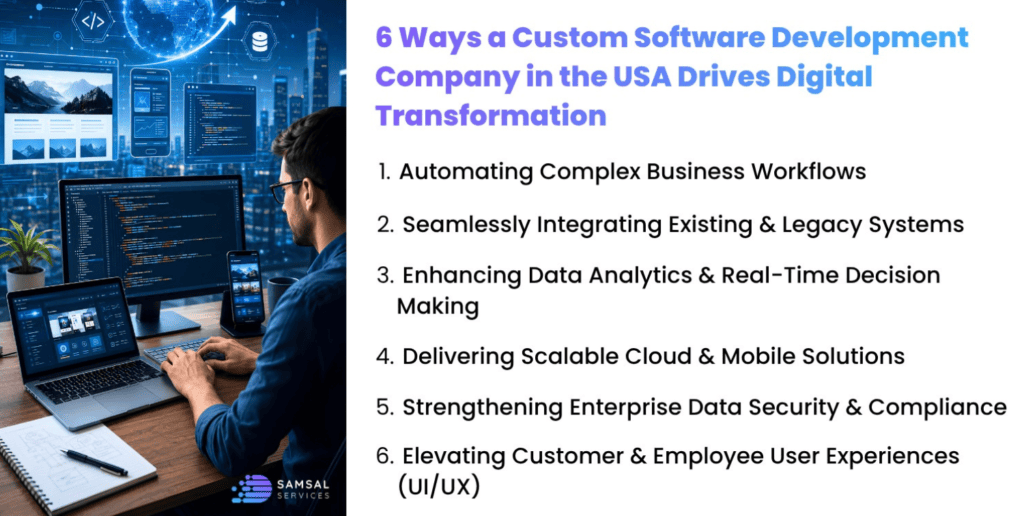
6 Ways a Custom Software Development Company in the USA Drives Digital Transformation
1. Automating Business Processes to Improve Efficiency
Manual processes can consume valuable time, increase operational costs, and create unnecessary errors. Tasks such as data entry, invoice processing, inventory updates, employee scheduling, and customer follow-ups often require repeated effort when businesses rely on disconnected tools.
Reducing Repetitive Manual Tasks
A tailored application can automatically assign tasks, send notifications, update records, and generate reports based on predefined business rules. For example, a distribution company can use custom software to update inventory when an order is processed, notify employees when stock levels fall below a specified threshold, and synchronize order information across departments.
This reduces repetitive administrative work and allows employees to focus on activities that require human judgment, communication, and problem-solving.
Improving Operational Accuracy
Automation can also reduce errors caused by duplicate data entry, inconsistent records, and missed deadlines. When information moves automatically between connected systems, teams can work with more consistent and up-to-date data.
A Custom Software Development Company in USA can assess existing workflows, identify bottlenecks, and develop automation features that improve efficiency without introducing unnecessary complexity.
2. Building Scalable Solutions for Growing Businesses
Business requirements change as organizations acquire customers, expand into new markets, introduce services, and increase transaction volumes. Software that works well for a small operation may struggle when the business grows.
Custom software development helps address this challenge by creating applications that can evolve alongside the organization.
Designing Software for Future Growth
Scalable software can accommodate additional users, larger databases, new features, and increased workloads. Developers may use modular architecture, cloud infrastructure, APIs, and appropriate database technologies to support future expansion.
For example, an e-commerce business may initially need a product catalog, shopping cart, and payment integration. As sales increase, it might require customer loyalty programs, advanced analytics, multiple warehouse integrations, and automated order management.
Supporting Flexible Business Requirements
Custom applications also allow organizations to prioritize features based on their needs rather than adapting every process to a standard software package. This flexibility can be particularly valuable for manufacturing, healthcare administration, logistics, wholesale distribution, and other industries with specialized workflows.
An experienced development partner can evaluate current requirements and recommend an architecture that balances immediate needs with long-term maintainability.
Scalability does not mean building every possible feature from the beginning. It means making thoughtful technical decisions that allow the software to grow without unnecessary cost or disruption.
3. Improving Customer Experience Through Personalized Solutions
Customer expectations continue to evolve. People increasingly expect convenient digital experiences, fast responses, accurate information, and consistent service across different channels.
Custom software can help businesses meet these expectations by providing digital tools tailored to their customers’ needs.
Creating User-Friendly Digital Experiences
Businesses can develop customer portals, mobile applications, online booking platforms, self-service dashboards, and personalized account experiences. These tools allow customers to access relevant information and complete tasks without depending entirely on manual assistance.
For example, a service company could provide a customer portal where users can submit requests, track project progress, review invoices, and communicate with support teams.
This creates a more convenient experience while reducing the administrative workload for employees.
Using Data to Personalize Customer Interactions
When implemented with appropriate privacy controls, custom software can use customer preferences, purchase history, and service interactions to deliver more relevant experiences.
An online retailer, for instance, could recommend products based on previous purchases or provide targeted updates about orders and promotions.
A CRM application can also help sales and support teams maintain accurate customer records, track conversations, and respond more effectively to inquiries.
A Custom Software Development Company in USA can combine user experience design, application development, and system integration to build digital experiences that strengthen customer relationships.
The result is a more consistent customer journey, improved service delivery, and greater opportunities to build customer loyalty.
4. Integrating Business Systems for Better Data Management
Many businesses use separate applications for accounting, inventory, sales, marketing, customer support, and human resources. When these systems do not communicate effectively, employees may need to transfer information manually or maintain duplicate records.
This creates information gaps and makes it difficult for decision-makers to obtain a complete view of business performance.
Connecting Disconnected Applications
Custom software can integrate existing business tools through APIs, middleware, and secure data exchange processes. Instead of replacing every application, businesses can connect the systems that already serve their needs.
For example, a wholesale distributor can connect its e-commerce platform, inventory management system, CRM, and accounting software. When a customer places an order, the relevant systems can receive the necessary information without repeated manual entry.
This improves coordination between departments and reduces delays caused by disconnected workflows.
Creating More Reliable Business Insights
Integrated systems can provide a more consistent view of operational data. Managers can review sales activity, inventory availability, customer orders, and financial information through connected dashboards and reporting tools.
However, integration alone does not guarantee accurate reporting. Organizations also need clear data ownership, validation rules, access controls, and consistent definitions for important business metrics.
A Leading IT Services Agency in the USA can help assess existing infrastructure, plan integrations, and implement suitable data management practices.
With better-connected systems, businesses can reduce information silos, improve reporting, and make decisions using more reliable data.
5. Strengthening Security and Supporting Compliance
As organizations become more dependent on digital systems, cybersecurity becomes a critical part of digital transformation. Customer information, financial records, employee data, and proprietary business information must be protected against unauthorized access and misuse.
Custom software development provides opportunities to incorporate security controls into an application from the planning stage.
Implementing Security by Design
Developers can implement role-based access controls, multi-factor authentication, encryption, secure API connections, input validation, and activity logging according to the application’s requirements.
These measures help limit access to sensitive information and reduce the risk of common security vulnerabilities.
For example, an enterprise application may allow finance employees to access billing records while restricting other users from viewing confidential financial information.
Security requirements should be defined before development begins and reviewed throughout the software lifecycle.
Maintaining Software and Managing Risk
Security is an ongoing responsibility. Businesses need regular updates, dependency monitoring, vulnerability assessments, secure backups, and incident response procedures.
Organizations operating in regulated industries may also need to address specific legal and contractual requirements. Depending on the industry and the data involved, these may include relevant privacy laws, healthcare requirements, or payment card security standards.
A responsible development partner can help identify applicable requirements and build appropriate safeguards into the solution. Compliance obligations should still be confirmed with qualified legal or compliance professionals.
6. Using Data Analytics and AI to Improve Decision-Making
Successful digital transformation depends on the ability to turn business data into actionable information. Organizations generate large amounts of data through customer interactions, sales transactions, internal operations, and digital platforms. Without the right tools, valuable insights can remain difficult to access.
Developing Real-Time Dashboards and Reports
A custom analytics dashboard can display key performance indicators (KPIs), sales trends, operational costs, inventory levels, customer activity, and other relevant metrics.
For instance, a manufacturing company could monitor production output, equipment downtime, order fulfillment, and material consumption through a centralized reporting system.
These insights help managers identify bottlenecks, evaluate performance, and make more informed operational decisions.
Applying AI and Predictive Analytics
Depending on the quality of available data and the business use case, custom applications can incorporate artificial intelligence (AI), machine learning, and predictive analytics.
For example, a retailer could use historical sales data and seasonal patterns to estimate future product demand. Managers could then use these forecasts to inform purchasing and inventory decisions. A Custom Software Development Company in USA can help businesses evaluate appropriate use cases and integrate analytics or AI capabilities into existing workflows.
How to Choose the Right Custom Software Development Partner
Selecting the right development partner is an important step in a successful digital transformation project. Businesses should look beyond development costs and consider the provider’s technical capabilities, communication practices, and ability to support the solution over time.
Evaluate Technical Expertise and Industry Experience
Look for a team with relevant experience in software architecture, web and mobile development, cloud technologies, APIs, databases, and cybersecurity. Industry experience can also help the team understand specialized workflows and regulatory considerations.
Prioritize Business Goals and Communication
A reliable provider should understand your business challenges before recommending a technical solution. Ask how the team gathers requirements, defines project milestones, manages scope changes, and measures success.
Consider Maintenance and Long-Term Support
Software requires ongoing maintenance after launch. Before choosing a provider, clarify how updates, bug fixes, security patches, performance monitoring, and future enhancements will be managed.
Working with a Leading IT Services Agency in the USA can be beneficial when a business needs coordinated support across software development, cloud infrastructure, integration, and other IT functions.
Frequently Asked Questions (FAQs)
1. What does a custom software development company in the USA do?
A custom software development company designs, builds, tests, and maintains software tailored to a business’s specific requirements. Its services may include web applications, mobile apps, CRM and ERP systems, workflow automation, API integrations, and data analytics solutions.
2. How does custom software development support digital transformation?
Custom software supports digital transformation by automating repetitive tasks, integrating disconnected systems, improving customer experiences, strengthening data management, and enabling better reporting.
3. Is custom software better than off-the-shelf software?
Neither option is always better. Off-the-shelf software can be suitable when standard features meet a business’s requirements and rapid deployment is important. Custom software may be more appropriate when an organization needs specialized workflows, deeper integrations, greater control over functionality, or unique business capabilities.
4. How much does custom software development cost in the USA?
The cost depends on project complexity, required features, integrations, design, security requirements, development time, and ongoing support. A relatively simple application generally requires fewer resources than a large enterprise platform with advanced analytics and multiple integrations.
Conclusion
Digital transformation helps businesses improve the way they operate, serve customers, and make decisions. Custom software plays an important role in this process by providing solutions designed around specific business requirements rather than forcing every operation into a standard system.
From automating workflows and supporting scalability to integrating applications, improving security, and enabling data-driven decisions, these six approaches demonstrate how tailored technology can create lasting business value.
Choosing the right development partner is equally important. A capable Custom Software Development Company in USA can help translate business challenges into practical software solutions, while a Leading IT Services Agency in the USA can provide broader technical guidance when transformation involves multiple systems and infrastructure.