Businesses across the USA are increasingly using artificial intelligence to automate repetitive tasks, improve customer experiences, and make faster decisions. From automated customer support to intelligent data processing, AI is changing how organizations manage everyday operations and compete in digital markets.
AI automation is no longer limited to large enterprises with extensive technology budgets. Small and mid-sized businesses can also use artificial intelligence to streamline workflows, reduce operational costs, and improve productivity. The key is identifying the right processes to automate and implementing solutions that can scale with business needs.
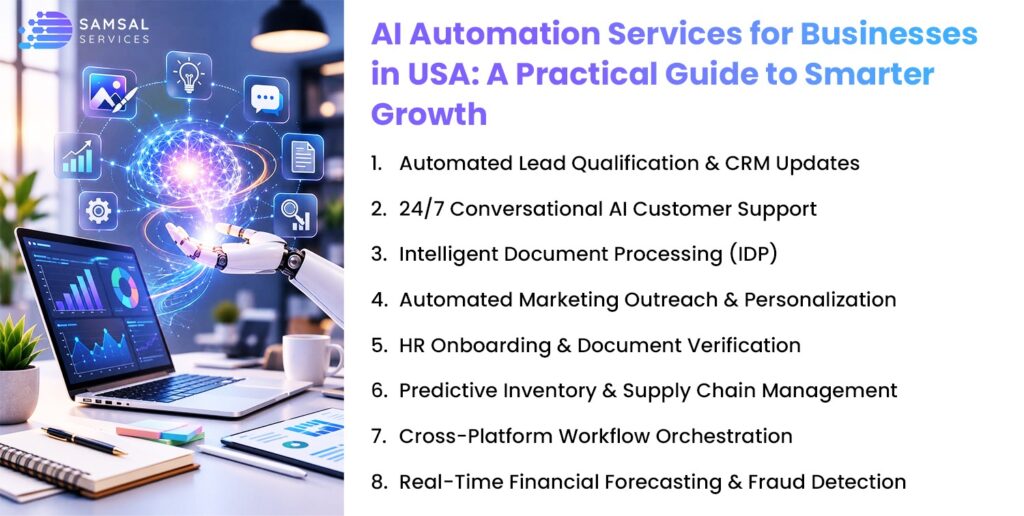
AI Automation Services for Businesses in USA help organizations integrate intelligent technologies into their existing operations. These services can include workflow automation, AI-powered chatbots, intelligent document processing, predictive analytics, customer service automation, sales automation, and customized AI applications.
What Are AI Automation Services?
AI automation services combine artificial intelligence with business process automation to reduce manual work and improve operational efficiency. Unlike traditional automation, which generally follows predefined rules, AI-powered systems can analyze information, identify patterns, understand language, and make recommendations based on available data.
For example, a traditional automation workflow may send an email whenever a customer submits a form. An AI-powered system can go further by analyzing the customer’s request, identifying its intent, assigning a priority level, and routing it to the appropriate department.
How AI Automation Works
AI automation typically combines several technologies, including:
- Machine learning
- Natural language processing
- Generative AI
- Robotic process automation
- Predictive analytics
- Computer vision
- APIs and business software integrations
These technologies allow businesses to automate processes while maintaining greater flexibility than conventional rule-based systems.
Common AI Automation Use Cases
Businesses can apply AI automation across multiple departments. Common use cases include customer support, marketing, sales, finance, human resources, inventory management, data entry, reporting, and internal operations.
The objective is not necessarily to automate an entire department. Instead, businesses can identify repetitive or time-consuming activities where AI can deliver measurable improvements.
Why Businesses in the USA Are Investing in AI Automation
The competitive business environment in the USA is encouraging organizations to find more efficient ways to operate. Rising operational costs, increasing customer expectations, growing data volumes, and the need for faster decision-making are all contributing to the adoption of AI-powered technologies.
Reduce Repetitive Manual Work
Employees often spend significant amounts of time performing repetitive administrative tasks. AI automation can handle many of these activities, allowing employees to focus on strategic and creative responsibilities.
For example, an organization can automate data extraction from documents, appointment scheduling, email classification, customer inquiries, and routine reporting.
Improve Operational Efficiency
Automated workflows can operate consistently without the delays associated with manual processing. Businesses can connect different applications and automate information movement between systems.
This can reduce unnecessary steps, minimize duplication, and help teams complete processes more efficiently.
Deliver Faster Customer Support
Customers expect quick responses regardless of the time of day. AI-powered virtual assistants and chatbots can provide immediate answers to common questions, collect customer information, and route complex issues to human representatives.
This creates a more responsive customer experience without requiring employees to manually handle every basic inquiry.
Support Better Business Decisions
AI systems can analyze large datasets more quickly than manual processes. Businesses can use AI-powered analytics to identify trends, forecast demand, evaluate customer behavior, and discover potential operational issues.
Better access to actionable insights can help management make informed decisions based on current business data.
Key AI Automation Services for Businesses
AI automation can be implemented in different forms depending on a company’s objectives, existing technology, and industry requirements.
AI-Powered Customer Service Automation
Customer service automation can help organizations manage frequently asked questions, appointment requests, order inquiries, and basic troubleshooting.
AI chatbots can interact with customers through websites, messaging platforms, and other digital channels. More advanced systems can use customer information and conversation history to provide more contextual responses.
Intelligent Workflow Automation
AI can connect multiple business processes and applications to create automated workflows.
For example, when a new lead enters a CRM, an AI automation system can evaluate the lead, categorize it, update the CRM, trigger an email sequence, and notify the appropriate sales representative.
This reduces manual data handling while helping sales teams respond more quickly.
AI Sales and Marketing Automation
AI can support marketing and sales teams by analyzing customer behavior, segmenting audiences, generating insights, and automating routine communications.
Businesses can use AI to identify potential leads, personalize marketing campaigns, analyze campaign performance, and prioritize prospects based on their likelihood of conversion.
Intelligent Document Processing
Many businesses still rely on documents containing invoices, contracts, forms, applications, and other operational information.
AI-powered document processing can extract relevant information, classify documents, identify important fields, and transfer data into business systems.
This can significantly reduce manual data entry and improve processing speed.
Predictive Analytics and Business Intelligence
AI automation can help businesses move beyond historical reporting toward predictive insights.
Predictive systems can analyze previous data to identify potential trends, estimate demand, detect anomalies, and support forecasting. These capabilities can be useful for inventory planning, sales forecasting, customer retention, and financial analysis.
How AI Automation Works With Cloud Technology
AI applications often require reliable infrastructure for data storage, computing, integrations, security, and scalability. Cloud environments can provide the flexibility required to support these requirements.
Businesses exploring AI adoption can combine AI automation with cloud modernization strategies to create a stronger technology foundation.
The Role of Cloud Transformation
Cloud transformation involves modernizing applications, infrastructure, data environments, and technology processes by using cloud-based platforms and services.
Businesses investing in cloud transformation services in USA can create infrastructure that supports modern applications while improving scalability and accessibility.
Cloud technology can also make it easier to integrate AI services with existing CRM, ERP, e-commerce, analytics, and communication platforms.
Scaling AI Applications
AI workloads can vary significantly depending on demand. Cloud infrastructure can provide scalable computing resources that allow businesses to accommodate changing workloads without relying entirely on fixed on-premises infrastructure.
This is particularly useful for businesses expecting their AI applications, data requirements, or customer usage to grow over time.
Industries That Can Benefit From AI Automation
AI automation is applicable across many industries because almost every organization has repetitive workflows, customer interactions, or data-intensive processes.
Healthcare
Healthcare organizations can use automation for appointment management, administrative workflows, patient communication, document processing, and data organization.
AI should be implemented carefully in healthcare environments, particularly where sensitive information and high-impact decisions are involved.
E-Commerce and Retail
Retail businesses can use AI for product recommendations, customer support, inventory forecasting, order processing, and marketing personalization.
Automation can help online businesses respond to customers faster while improving the efficiency of internal operations.
Manufacturing
Manufacturers can use AI automation for predictive maintenance, quality control, inventory management, production analytics, and supply chain optimization.
AI-powered systems can analyze operational data and identify patterns that may be difficult to detect through manual analysis.
Financial Services
Financial organizations can use AI to automate document processing, customer service, fraud detection, risk analysis, and reporting.
Because financial data is highly sensitive, security, compliance, governance, and human oversight should be incorporated into AI automation projects.
Professional Services
Law firms, consulting companies, marketing agencies, accounting firms, and other professional service providers can automate administrative tasks, document workflows, client communication, reporting, and internal knowledge management.
How to Choose the Right AI Automation Strategy
Implementing AI without a clear business objective can result in unnecessary complexity and expenses. Organizations should first identify processes where automation can produce measurable value.
Identify Repetitive Processes
Start by reviewing workflows that require significant manual effort. Look for tasks that are repetitive, time-consuming, data-heavy, or prone to human error.
These processes are often strong candidates for automation.
Define Measurable Objectives
Businesses should establish clear goals before implementing an AI solution. Possible objectives include reducing processing time, improving customer response rates, decreasing operational costs, or increasing employee productivity.
Clear objectives make it easier to measure the success of an AI project.
Evaluate Existing Technology
AI automation should work with the organization’s existing technology ecosystem whenever possible.
Businesses should evaluate their CRM, ERP, website, databases, communication tools, cloud infrastructure, and other critical applications before selecting an automation approach.
Prioritize Security and Governance
AI automation can involve sensitive customer, employee, financial, or operational information. Businesses should establish appropriate access controls, data protection measures, monitoring, and governance processes.
Human review should remain part of workflows where AI-generated decisions could have significant consequences.
Benefits of Working With an AI Automation Service Provider
Building an effective AI automation system requires more than simply adding an AI tool to an existing workflow. Businesses need to consider architecture, integrations, data quality, security, scalability, and ongoing maintenance.
An experienced service provider can assess existing processes and identify practical opportunities for automation.
Customized Solutions
Every organization has different workflows and technology requirements. Customized AI solutions can be designed around specific business processes rather than forcing teams to change everything around a generic tool.
Integration With Existing Systems
AI automation becomes more valuable when it connects with the software businesses already use. Integrations with CRM, ERP, e-commerce platforms, databases, communication tools, and cloud environments can create connected workflows.
Scalable Technology
A properly designed AI automation solution can evolve as business requirements change. New workflows, integrations, data sources, and AI capabilities can be added over time.
This makes scalability an important consideration when selecting an AI automation partner.
How Much Do AI Automation Services Cost?
The cost of AI automation depends on several factors, including the complexity of the workflow, number of integrations, AI models used, data requirements, security requirements, and ongoing maintenance.
A simple chatbot or workflow automation project may require significantly less investment than a customized enterprise AI platform connected to multiple business systems.
Instead of focusing only on initial development costs, businesses should evaluate the potential return on investment. Time saved, increased productivity, improved customer retention, reduced operational costs, and higher revenue opportunities can all contribute to the overall value of an AI automation project.
What Does the Future of AI Automation Look Like?
AI automation is expected to become increasingly integrated into everyday business operations. AI Automation Services for Businesses in USA will play an important role in helping organizations move beyond isolated AI tools toward connected systems that can understand business data, coordinate workflows, and assist employees across multiple functions.
Generative AI, AI agents, predictive analytics, intelligent search, and automated decision-support systems are likely to play increasingly important roles in modern business environments. By adopting these technologies, companies can streamline repetitive tasks, improve operational efficiency, and make more informed decisions.
However, successful adoption will depend on responsible implementation. Businesses that combine AI capabilities with strong data governance, human oversight, cybersecurity, and scalable infrastructure will be better positioned to gain sustainable value from automation.
Frequently Asked Questions About AI Automation Services
1. What are AI automation services for businesses?
AI automation services use artificial intelligence to automate repetitive business processes, analyze data, support customer interactions, and improve operational workflows. They can include chatbots, intelligent document processing, predictive analytics, workflow automation, and AI-powered business applications.
2. Can small businesses use AI automation?
Yes. Small businesses can use AI automation for customer support, lead management, appointment scheduling, marketing, document processing, reporting, and other repetitive tasks.
3. How do cloud transformation services support AI automation?
Cloud transformation can provide scalable infrastructure, data storage, computing resources, application integration, and modern technology environments needed for AI solutions.
4. How should a business start an AI automation project?
A business should begin by identifying repetitive or time-consuming processes, defining measurable objectives, evaluating its existing technology, and determining where AI can provide practical value.
Conclusion
AI is changing how businesses operate, serve customers, manage data, and make decisions. For organizations across the USA, AI automation can provide a practical way to reduce repetitive work, improve productivity, accelerate customer service, and build more efficient workflows.
AI Automation Services for Businesses in USA can range from simple workflow automation to sophisticated AI-powered applications integrated with CRM, ERP, cloud, analytics, and other business systems. The right approach depends on each organization’s goals, processes, technology environment, and growth plans.
Businesses should also consider the infrastructure supporting their AI initiatives. Combining intelligent automation with cloud modernization can create a scalable foundation for future technology adoption.