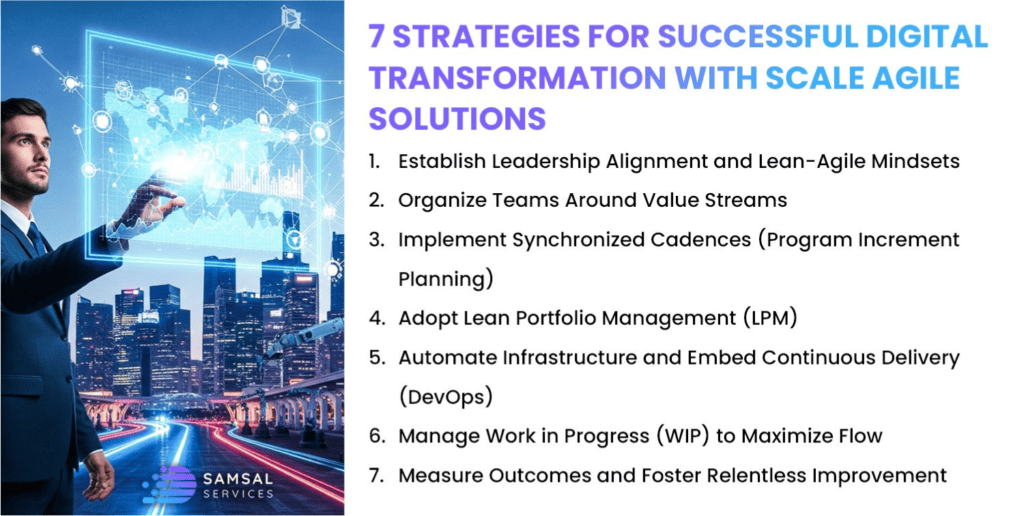
Digital transformation is no longer simply about adopting new software or moving business operations to the cloud. It is about changing how an organization operates, serves customers, manages data, and responds to market demands. Yet, many transformation initiatives struggle because technology implementation moves faster than organizational readiness.
This is where digital transformation scale agile solutions can make a significant difference. By combining digital technologies with scalable Agile practices, businesses can break large transformation programs into manageable initiatives, improve collaboration, accelerate delivery, and continuously adapt to changing priorities.
What Are Digital Transformation Scale Agile Solutions?
Traditional Agile works effectively for individual development teams, but enterprise transformation often involves dozens of teams working toward shared objectives. Scaling Agile introduces structured coordination, shared priorities, continuous feedback, and consistent delivery practices across the organization.
A successful approach typically connects:
- Business strategy and technology goals
- Product development and customer needs
- Cross-functional teams and leadership
- Continuous delivery and performance measurement
- Innovation and operational efficiency
The objective is not simply to become “more Agile.” The goal is to create an organization that can respond faster, deliver better products, and continuously improve its digital capabilities.
Why Businesses Need a Scalable Digital Transformation Strategy
Digital transformation affects almost every part of an organization. A company may need to modernize applications, integrate data, automate workflows, improve cybersecurity, redesign customer journeys, and introduce new digital products simultaneously.
Without a coordinated approach, these projects can become disconnected.
A scalable Agile strategy creates a common operating model that helps teams work toward shared business outcomes. It provides the flexibility to experiment while establishing enough governance to keep enterprise initiatives aligned.
Businesses can benefit through:
- Faster product and feature delivery
- Better collaboration between business and IT
- More efficient use of development resources
The following seven strategies can help organizations build a more effective transformation program.
1. Align Digital Transformation With Business Goals
Technology should never become the objective of transformation. Business outcomes should come first.
Before selecting platforms, frameworks, or development tools, organizations should clearly define what they want to accomplish. This could include increasing operational efficiency, improving customer retention, entering new markets, reducing costs, or launching digital products faster.
Define Measurable Transformation Objectives
Instead of using vague goals such as “modernize the business,” establish measurable objectives.
For example:
- Reduce application processing time by 30%.
- Decrease manual administrative work.
- Improve customer onboarding.
- Increase digital sales conversions.
- Reduce software release cycles.
These objectives give Agile teams a clear direction.
Connect Teams to Business Outcomes
Every Agile team should understand how its work contributes to a larger organizational goal. This reduces disconnected development efforts and encourages teams to prioritize initiatives based on business value.
When transformation becomes outcome-driven, organizations can make better decisions about which projects deserve investment and which should be changed or discontinued.
2. Build Cross-Functional Agile Teams
Successful transformation requires more than developers and IT specialists. Business analysts, designers, product managers, marketing professionals, security specialists, operations teams, and business leaders may all contribute to a digital initiative.
Reduce Departmental Silos
When teams operate independently, information often becomes fragmented. A development team may understand technical requirements but lack insight into customer expectations, while business teams may understand customer problems but have limited visibility into technical constraints.
Cross-functional teams bring these perspectives together.
Create Shared Accountability
Teams should be responsible for outcomes rather than simply completing assigned tasks.
For example, instead of measuring a team solely by the number of features delivered, organizations can evaluate whether those features improve customer satisfaction, increase engagement, reduce costs, or support revenue growth.
This shift creates a stronger connection between Agile delivery and business performance.
3. Modernize Legacy Technology Incrementally
Legacy systems are one of the biggest obstacles to digital transformation. Replacing everything at once can be expensive, disruptive, and risky.
A better approach is incremental modernization.
Prioritize Systems Based on Business Impact
Organizations should assess legacy applications according to factors such as:
- Business criticality
- Maintenance costs
- Security risks
- Integration challenges
- Scalability
- Customer impact
- Technical complexity
This helps determine which systems should be replaced, re-engineered, integrated, or retained.
Use Incremental Delivery
Rather than attempting a complete technology overhaul, Agile teams can modernize systems in stages. APIs, cloud services, modular architecture, and integration platforms can help organizations gradually transition away from outdated infrastructure.
This reduces disruption while allowing the business to start receiving value earlier.
4. Establish a Strong Product and Portfolio Management Process
Scaling Agile requires more than coordinating development teams. Organizations also need a clear method for deciding which initiatives receive resources and how those initiatives support strategic priorities.
Prioritize High-Value Initiatives
Not every digital project has equal value. Product and portfolio leaders should consider:
- Customer impact
- Business value
- Implementation complexity
- Strategic importance
- Risk
- Expected return on investment
Agile prioritization allows organizations to focus resources on initiatives that can produce meaningful results.
Maintain a Transparent Roadmap
A shared roadmap gives executives, product teams, developers, and stakeholders visibility into transformation priorities.
It also makes it easier to adjust plans when market conditions change.
For example, if customer behavior shifts unexpectedly, an organization can redirect resources toward a higher-priority digital initiative rather than continuing a project simply because it was included in an old plan.
5. Adopt Continuous Delivery and Automation
Digital transformation depends on an organization’s ability to deliver improvements consistently. Manual processes can slow development, increase errors, and make frequent releases difficult.
Automation can help Agile teams establish a more reliable delivery pipeline.
Implement CI/CD Practices
Continuous integration and continuous delivery can automate significant parts of the software development lifecycle. Code can be tested, validated, and prepared for deployment more consistently.
Automate Repetitive Work
Automation can extend beyond software deployment. Organizations can automate testing, infrastructure provisioning, monitoring, reporting, data workflows, and other repetitive activities.
The result is a faster and more predictable transformation process.
6. Use Data and Feedback to Drive Decisions
Agile transformation should be based on evidence rather than assumptions.
Organizations should continuously collect information about system performance, customer behavior, employee productivity, and product adoption.
Define Relevant KPIs
Useful transformation metrics may include:
- Deployment frequency
- Lead time for changes
- Application performance
- Customer satisfaction
- Digital adoption
- Conversion rates
- Operational costs
The right metrics depend on the organization’s objectives.
Create Continuous Feedback Loops
Teams can use this information to refine products and processes during the transformation instead of waiting until the end of a large project.
This is one of the key advantages of digital transformation scale agile solutions: organizations can learn and adapt throughout the process.
7. Work With the Right Technology Partner
Large-scale transformation can involve complex decisions involving cloud architecture, software development, cybersecurity, data management, APIs, automation, UX, and enterprise systems.
The right technology partner can provide technical expertise while helping businesses maintain strategic alignment.
Look Beyond Technical Skills
When evaluating an IT partner, consider whether the provider understands business objectives, Agile delivery, digital product development, enterprise architecture, and long-term scalability.
A trusted IT agency in the USA should be able to understand the organization’s challenges before recommending a technology solution.
Prioritize Long-Term Collaboration
Digital transformation is rarely a one-time project. Businesses often need ongoing optimization, security updates, application improvements, infrastructure management, and product development.
Common Challenges in Scaling Digital Transformation
Even a well-designed strategy can face obstacles. Recognizing these challenges early can improve transformation outcomes.
Resistance to Organizational Change
Employees may resist new workflows, tools, or responsibilities. Leadership should clearly communicate why the transformation is happening and how it benefits both the organization and its teams.
Training, transparent communication, and employee involvement can make adoption easier.
Lack of Executive Alignment
Transformation initiatives can lose momentum when leadership teams have different priorities.
Executives should establish clear strategic goals and consistently communicate them across the organization.
Too Many Projects at Once
Launching too many initiatives can spread resources too thin. A focused portfolio of high-value projects is often more effective than attempting to transform everything simultaneously.
Measuring Activity Instead of Outcomes
Counting completed tasks does not necessarily indicate transformation success.
Organizations should measure business outcomes such as customer experience, revenue impact, productivity, cost reduction, and operational performance.
How to Make Digital Transformation More Sustainable
Successful transformation should create capabilities that continue delivering value after the initial implementation.
Organizations should invest in employee skills, scalable architecture, documentation, security, data governance, and continuous improvement.
A sustainable transformation model typically includes:
- Clear strategic objectives
- Strong leadership support
- Cross-functional collaboration
- Scalable technology architecture
- Continuous delivery
- Data-driven decision-making
- Regular performance reviews
This approach turns transformation from a temporary technology project into an ongoing organizational capability.
Frequently Asked Questions
1. What are digital transformation scale Agile solutions?
Digital transformation scale Agile solutions combine digital technologies with Agile methodologies designed to coordinate multiple teams and business functions.
2. Why is Agile important for digital transformation?
Agile enables organizations to break large transformation initiatives into smaller deliverables. Teams can gather feedback, respond to changing requirements, reduce project risk, and deliver business value faster instead of waiting until the end of a lengthy project.
3. How long does a digital transformation take?
There is no universal timeline. The duration depends on the organization’s size, technology environment, objectives, legacy systems, resources, and transformation scope.
4. How can a business choose the right IT partner?
Businesses should evaluate an IT partner based on technical expertise, industry understanding, Agile experience, communication, security practices, scalability, and its ability to connect technology decisions with measurable business outcomes.
Conclusion
Digital transformation succeeds when technology, people, processes, and business strategy move in the same direction. The seven strategies outlined above provide a practical foundation for transformation: align technology with business goals, build cross-functional teams, modernize legacy systems incrementally, manage portfolios strategically, automate delivery, use data for continuous improvement, and select the right technology partner.
Ultimately, digital transformation scale agile solutions are not about implementing Agile for its own sake. They are about creating a scalable operating model that helps businesses innovate faster, reduce risk, and continuously deliver measurable value.
With the support of a trusted IT agency in the USA, organizations can combine strategic planning, modern technology, Agile execution, and continuous optimization to build a stronger digital future.